
ノーマルビュー

世界初 共振で結晶の屈曲を大きく増幅

著者: contributor
2023年3月29日 17:31

結晶の共振固有振動による大きく高速な屈曲を世界で初めて発見

メカニカル結晶はアクチュエータやソフトロボットへ実用化する段階に到達

発表のポイント

光や熱などの外部刺激を動きに変換する「メカニカル結晶」の開発において、これまで光異性化・相転移・光熱効果などの現象が駆動源として用いられましたが、高速かつ大きな動きを創出することは難しく、課題でした。

本研究グループは、結晶に光を当てることで固有振動が起きて高速屈曲が生じ、この固有振動と同じ周波数の光を与えることによって生じる共振(共振固有振動)により、屈曲が大きく増幅することを世界で初めて発見しました。

共振固有振動を用いることであらゆる結晶を高速で大きく屈曲させることができるため、汎用性のある高速アクチュエーション機構として、ソフトロボットなどへの応用が期待されます。

早稲田大学(東京都新宿区、総長:田中愛治)ナノ・ライフ創新研究機構の小島秀子(こしまひでこ)招聘研究員と、同大理工学術院朝日透(あさひとおる)教授、同大学大学院先進理工学研究科4年(一貫制博士課程4年)・日本学術振興会特別研究員(DC1)の萩原佑紀(はぎわらゆうき)らの研究グループ(以下、本研究グループ)は、東京工業大学(東京都目黒区、学長:益一哉)物質理工学院の森川淳子(もりかわじゅんこ)教授らと、結晶に光を当てることで固有振動が起きて高速屈曲が生じることを発見しました。さらにこの固有振動と同じ周波数の光を与えることで、共振により屈曲が大きく増幅することを世界で初めて発見しました。今回の共振固有振動を用いることで、汎用性の高い高速結晶アクチュエータやソフトロボットの実現が期待されます。

本研究成果は、Springer Nature社発行による『Nature Communications』誌のオンライン版に2023年3月13日(月)(現地時間)に掲載されました。

論文名:Photothermally induced natural vibration for versatile and high-speed actuation of crystals

(1)これまでの研究で分かっていたこと(科学史的・歴史的な背景など)

光や熱などの外部刺激を動きに変換する「メカニカル結晶」は、軽くて柔らかいアクチュエータ※1やソフトロボット※2への応用が期待されています(参考文献1)。私たちは過去15年間、結晶を動かす原理として、光異性化※3(参考文献2)や相転移※4(参考文献3)に注目して、多数のメカニカル結晶を開発しました。しかし、光異性化や相転移する結晶は数が限られています。特に、光異性化については屈曲する動きが遅く(数秒)、厚い結晶は屈曲しないといった問題点がありました(参考文献4)

本研究グループは2020年、光熱効果※5によって厚い結晶が25 Hzの高速で屈曲することを発見しました(参考文献5)。その後、別の結晶を用いて、光熱効果による屈曲の機構をシミュレーションにより明らかにしました(参考文献6)。しかし、この光熱効果による屈曲は小さく(0.2–0.5度)、大きな動きを創出することが課題でした。

(2)今回の研究で新たに実現しようとしたこと、明らかになったこと

物体に外力を加えると、特有の周波数(固有振動数)で振動し続ける現象を固有振動といいます。この固有振動と同じ周波数の外力を加えると、共振と呼ばれる現象が発生して、振動が増幅されます。例えば、地震の際、建物の固有振動数と地震の周波数が一致すると共振して激しく揺れ、倒壊する恐れがあります。ギターやサックスなどの楽器は、弦やリードの動きで音(振動)を作り、箱や筒の中で共振させることで音を増幅しています。このように固有振動は私たちの日常に広く関わっていますが、動く材料を創るという観点では注目されていませんでした。
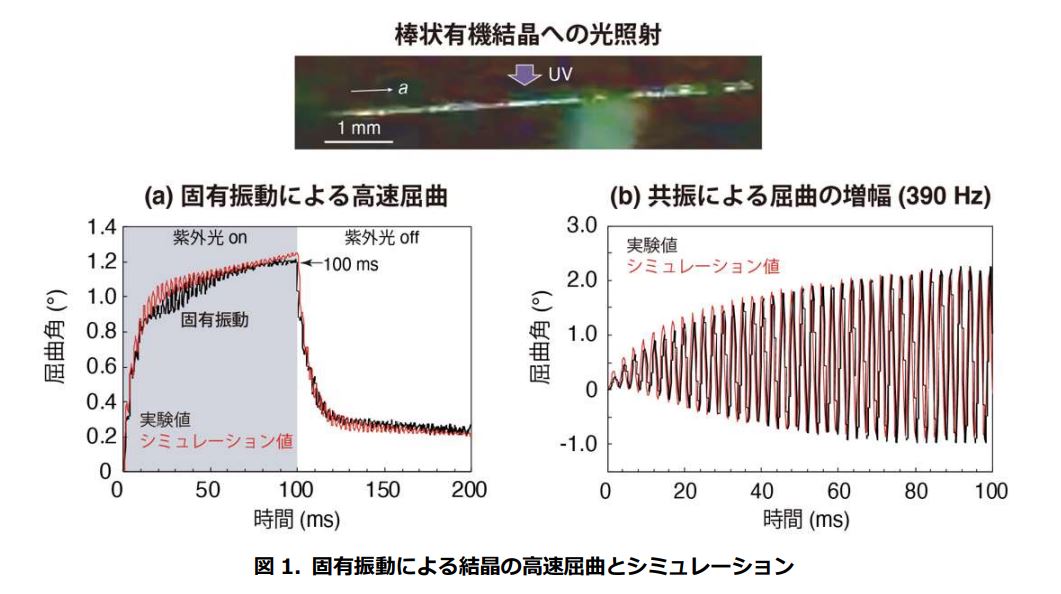
本研究の最初の目的は、熱膨張の大きい有機結晶に注目して、光熱効果による大きな屈曲を創出することでした。その研究中に、100ミリ秒で1.2度の光熱効果による大きな屈曲と同時に、390 Hzの高速で0.1度の微小な固有振動が起きていることを初めて発見しました(黒、図1a)。驚くことに、この固有振動と同じ390 Hzのパルス光を照射すると、共振により固有振動が3.4度に増幅されました(黒、図1b)。つまり、共振固有振動によって、結晶の高速で大きな屈曲が創出できることを世界で初めて発見しました。

この仕組みを解明するため、本研究グループは、光熱効果による熱が結晶内を伝導してできた温度勾配により結晶が変形し、同時に生じた熱応力※6が結晶の振動を起こすという機構を仮定し、結晶の屈曲をシミュレーションしました。その結果、共振を伴わない屈曲と共振により増幅された屈曲の両方を再現することができました(赤、図1a, b)。

さらに、結晶の形状を変えると200­–700 Hzの様々な共振固有振動が観察され、長く薄い結晶では「大きい屈曲」が、短く厚い結晶では「素早い屈曲」が創出できることがわかりました(図2a)。この共振固有振動について屈曲速度とエネルギー変換効率(光→屈曲運動)を、光異性化、光熱効果、非共振固有振動による屈曲と比較した結果、最も速い屈曲速度(0.2–0.7 m s-1)かつ最も高いエネルギー変換効率(~0.1 %)が得られることがわかりました(図2b)。

(3)そのために新しく開発した手法

正確な周波数のパルス光を照射するため、電子工作に広く用いられているArduino※7による制御システムを構築しました。光熱効果と固有振動の合わさった屈曲をシミュレーションするため、物体のあらゆる物理現象の計算に適している有限要素法※8を用いました。

(4)研究の波及効果や社会的影響

本研究において共振固有振動によって結晶を高速で大きく屈曲させられることを初めて発見し、シミュレーションによる再現にも成功しました。固有振動の共振に注目することで、あらゆる結晶を高速で大きく屈曲させることが可能です。また屈曲はシミュレーションできるため、結晶の種類やサイズ、光の照射条件などを変えれば望みの動きを設計することができます。

最終的にはこれまでの光異性化や相転移では難しかった、汎用性の高い高速結晶アクチュエータやソフトロボットの実現に期待が高まります。このような実用化へのアプローチにより、ヒトとロボットが融和して日常的に触れ合う、未来社会の創成に貢献できます。

(5)今後の課題

現状、固有振動で結晶が動く例はまだ本研究の1例のみなので、今後は別の結晶についても検討し共振固有振動の汎用性について実証する必要があります。さらに高速な固有振動を起こすことが出来れば、幅広い応用先の考案につながるため、高い固有振動数を持つヤング率※9の高い結晶に注目し検討する必要があると考えます。

(6)研究者のコメント

光で動く結晶はこの15年間で多数報告されてきました。今回、本研究グループの発見により、共振固有振動を用いてあらゆる結晶を高速で大きく動かせることがわかりました。本研究により、メカニカル結晶は実際にアクチュエータやソフトロボットへ実用化する段階に進んだと考えています。今後はアクチュエータやソフトロボットへの応用にも挑戦し、基礎研究から実用化まで、幅広く研究を展開したいと思います。

(7)用語解説

※1 アクチュエータ

光や電気といった入力信号を動きに変換する素子。

※2 ソフトロボット

金属など固い材料を用いず、柔らかい材料のみからなるロボット。

※3 光異性化

ある分子が光を吸収して別の分子に変化すること。

※4 相転移

光や熱などにより、材料がある状態から別の状態に変化すること。

※5 光熱効果

物質が光を吸収して熱を発生すること。

※6 熱応力

材料が熱的に膨張することで生じる力。

※7 Arduino

電気機器を制御するコンピュータの一種。

※8 有限要素法

物理現象を近似的に解くための数値解析手法。

※9 ヤング率

材料の変形しにくさを表す物性値。

参考文献】

  1. Koshima H. (ed) Mechanically Responsive Materials for Soft Robotics (2020). DOI: 10.1002/978352782220
  2. Koshima H. et al., Am. Chem. Soc., 2009. DOI: 10.1021/ja8098596
  3. Taniguchi T. et al., Commun., 2018. DOI: 10.1038/s41467-017-02549-2
  4. Koshima H. et al., J. Chem., 2021. DOI: 10.1002/ijch.202100093
  5. Hagiwara Y. et al., Mater. Chem. C., 2020. DOI: 10.1039/d0tc00007h
  6. Hasebe S. et al., Am. Chem. Soc., 2021. DOI: 10.1021/jacs.1c03588

(8)論文情報

雑誌名:Nature Communications
論文名:Photothermally induced natural vibration for versatile and high-speed actuation of crystals
執筆者名(所属機関名):Yuki Hagiwara*a, Shodai Hasebe*a, Hiroki Fujisawa*b, Junko Morikawa*b, Toru Asahi*a, Hideko Koshima*a   
*a: 早稲田大学、*b: 東京工業大学
掲載日(現地時間):2023年3月13日(月)
掲載日(日本時間):2023年3月13日(月)
掲載URL:https://www.nature.com/articles/s41467-023-37086-8
DOI10.1038/s41467-023-37086-8

(9)研究助成(外部資金による助成を受けた研究実施の場合)

研究費名:文部科学省 科研費 基盤研究(B)
研究課題名:熱と光で自在に動くロボット結晶の開発
研究代表者名(所属機関名):小島 秀子(早稲田大学)

研究費名:文部科学省 科研費 特別研究員奨励費
研究課題名:光熱効果によるメカニカル結晶材料の多様化と可能性の拡大
研究代表者名(所属機関名):萩原 佑紀(早稲田大学)

研究費名:早稲田大学 アーリーバードプログラム
研究課題名:光熱駆動高速結晶メカニカルリレーの開発
研究代表者名(所属機関名):萩原 佑紀(早稲田大学)

最新の注目研究者をピックアップ

著者: contributor
2023年3月29日 09:42

早稲田大学の最新の注目研究者をピックアップした動画:Research Recap at Waseda University 2023を公開しました。是非ご覧ください。

本動画に登場する研究者

0:04  所千晴教授 (理工学術院)

研究分野:Environmental materials and recycling technology
Recent research: A Novel, Single Electrical Pulse Method for the Recycling of Lithium-Ion Battery Cathodes 
Researcher details: https://w-rdb.waseda.jp/html/100000777_en.html
2021年度早稲田大学リサーチアワード(大型研究プロジェクト推進)受賞者

0:11  三宅丈雄教授  (理工学術院)

研究分野:Soft electronics and biomedical engineering
Recent research: Controlling Biological Cells Electrochemically with Bioiontronics
Researcher details: https://w-rdb.waseda.jp/html/100001422_en.html
2022年度早稲田大学PI飛躍プログラム支援対象者

0:22  コアド アレックス教授  (商学学術院)

研究分野:Business Economics and Entrepreneurship
Recent research: Growth Patterns and Exit Routes of Firms in Japan
Researcher details: https://w-rdb.waseda.jp/html/100002156_en.html
2021年度早稲田大学リサーチアワード(国際研究発信力)受賞者

0:28 大久保將史教授  (理工学術院)

研究分野:Batteries for a carbon neutral society
Recent research: Novel Materials and Optimal Electrochemical Conditions for Enhancing Ecofriendly Aqueous Batteries
Researcher details: https://w-rdb.waseda.jp/html/100002881_en.html
2021年度早稲田大学リサーチアワード(国際研究発信力)受賞者

0:36 有村俊秀教授  (政治経済学術院)

研究分野:Carbon Pricing: Emissions Trading and Carbon Tax
Recent research: Impact of Regional Emission Trading Systems on a Firm’s Overall Carbon Footprint
Researcher details: https://w-rdb.waseda.jp/html/100000111_en.html
次代の中学研究者2021

0:46 原太一教授  (人間科学学術院)

研究分野:Autophagy and food sciences
Recent research: Dietary Regulation of Autophagy for a Long and Healthy Life
Researcher details: https://w-rdb.waseda.jp/html/100001493_en.html

0:53 渡邊克巳教授 (理工学術院)

研究分野:Cognitive science and Experimental psychology
Recent research: How do our own voices affect our emotional states?
Researcher details: https://w-rdb.waseda.jp/html/100001331_en.html
次代の中学研究者2021

1:04 青木隆朗教授 (理工学術院)

研究分野:Quantum optics
Recent research: Towards Distributed Quantum Computing with Photon-based Coupling between Distant Atoms
Researcher details: https://w-rdb.waseda.jp/html/100001117_en.html
次代の中学研究者2021

1:13 田中雅史講師 (文学学術院)

研究分野:Neuroscience
Recent research: Dopamine Drives Cultural Transmission of Song Learning in Zebra Finches 
Researcher details: https://w-rdb.waseda.jp/html/100001998_en.html
2022年度早稲田大学PI飛躍プログラム支援対象者

ご卒業・修了おめでとうございます。2022年度学位授与式が行われました。

著者: staff
2023年3月27日 16:09

3月26日(日)、西早稲田キャンパスにおいて学科・専攻ごとの学位授与式が行われました。ご卒業・修了を迎えられた皆さん、おめでとうございます。今後のご活躍をお祈りしています!


〔お知らせ〕実験装置リモート化プロモーションビデオの公開について

著者: contributor
2023年3月27日 09:59

材研の提案する実験装置のリモート化


早稲田大学各務記念材料技術研究所(以下、材研)は文部科学省より共同利用・共同研究拠点の認定を受け、「環境整合材料基盤技術共同研究拠点」の名のもと、多様な研究を展開しています。

共同利用・共同研究により、日本各地の多くの研究者が材研を利用していますが、新型コロナウイルス感染症の拡大により移動が制限され、研究の遂行が困難になった時期がありました。このことを受け、材研では各種実験装置のリモート化、すなわち電子顕微鏡など分析装置の観察像を遠隔地からリアルタイムで共有できる仕組みの構築に着手しました。

現在では社会全体がポストコロナの流れになり、コロナ前のような移動も可能になりつつありますが、「リモートで対応できることは今後もリモートで」という新しい考え方・行動様式により、材研が提案する実験装置のリモート化は引き続き重要なコンセプトであると考えています。

しかし、実験装置のリモート化と言っても実際どのように利用するのか、なかなかイメージが難しいのではないでしょうか?そこで実験装置のリモート化について紹介するための動画を制作しました。この動画をご覧いただき、ぜひ材研の利用をご検討ください。

研究設備とその利用方法はこちらをご覧ください。


2023年3月
早稲田大学各務記念材料技術研究所

A Sowing, Pruning, and Harvesting Robot for Synecoculture Farming

著者: contributor
2023年3月22日 11:01

A Sowing, Pruning, and Harvesting Robot for SynecocultureTM Farming

Researchers develop a four-wheeled, two orthogonal axes mechanism robot to maintain plants grown under solar panels

Synecoculture, a new farming method, involves growing mixed plant species together in high density. However, it requires complex operation since varying species with different growing seasons and growing speeds are planted on the same land. To address this need, researchers have developed a robot that can sow, prune, and harvest plants in dense vegetation grown. Its small, flexible body will help large-scale Synecoculture. This is an important step towards achieving sustainable farming and carbon neutrality.

Researchers have developed a small and flexible agricultural robot for Synecoculture farming. It has a four-wheel mechanism, two axes stand, robotic arm, camera unit, maneuvering system, and farming tools.

Synecoculture is a new agricultural method advocated by Dr. Masatoshi Funabashi, senior researcher at Sony Computer Science Laboratories, Inc. (Sony CSL), in which various kinds of plants are mixed and grown in high density, establishing rich biodiversity while benefiting from the self-organizing ability of the ecosystem. However, such dense vegetation requires frequent upkeep—seeds need to be sown, weeds need to be pruned, and crops need to be harvested. Synecoculture thus requires a high level of ecological literacy and complex decision-making. And while the operational issues present with Synecoculture can be addressed by using an agricultural robot, most existing robots can only automate one of the above three tasks in a simple farmland environment, thus falling short of the literacy and decision-making skills required of them to perform Synecoculture. Moreover, the robots may make unnecessary contact with the plants and damage them, affecting their growth and the harvest.

With the rising awareness of environmental issues, such a gap between the performance of humans versus that of conventional robots has spurred innovation to improve the latter.

A group of researchers led by Takuya Otani, an Assistant Professor at Waseda University, in collaboration with Sustainergy Company and Sony CSL, have designed a new robot that can perform Synecoculture effectively. The robot is called SynRobo, with “syn” conveying the meaning of “together with” humans. It manages a variety of mixed plants grown in the shade of solar panels, an otherwise unutilized space. An article describing their research was published in Volume 13, Issue 1 of Agriculture, on 21 December 2022. This article has been co-authored by Professor Atsuo Takanishi, also from Waseda University, other researchers of Sony CSL, and students from Waseda University.

Otani briefly explains the novel robot’s design. “It has a four-wheel mechanism that enables movement on uneven land and a robotic arm that expands and contracts to help overcome obstacles. The robot can move on slopes and avoid small steps. The system also utilizes a 360o camera to recognize and maneuver its surroundings. In addition, it is loaded with various farming tools—anchors (for punching holes), pruning scissors, and harvesting setups. The robot adjusts its position using the robotic arm and an orthogonal axes table that can move horizontally.”  

Besides these inherent features, the researchers also invented techniques for efficient seeding. They coated seeds from different plants with soil to make equally-sized balls. These made their shape and size consistent, so that the robot could easily sow seeds from multiple plants. Furthermore, an easy-to-use, human-controlled maneuvering system was developed to facilitate the robot’s functionality. The system helps it operate tools, implement automatic sowing, and switch tasks.

The new robot could successfully sow, prune, and harvest in dense vegetation, making minimal contact with the environment during the tasks because of its small and flexible body. In addition, the new maneuvering system enabled the robot to avoid obstacles 50% better while reducing its operating time by 49%, compared to a simple controller.

“This research has developed an agricultural robot that works in environments where multiple species of plants grow in dense mixtures,” Otani tells us. “It can be widely used in general agriculture as well as Synecoculture—only the tools need to be changed when working with different plants. This robot will contribute to improving the yield per unit area and increase farming efficiency. Moreover, its agricultural operation data will help automate the maneuvering system. As a result, robots could assist agriculture in a plethora of environments. In fact, Sustainergy Company is currently preparing to commercialize this innovation in abandoned fields in Japan and desertified areas in Kenya, among other places.”

Such advancements will promote Synecoculture farming, with the combination of renewable energy, and help solve various pressing problems, including climate change and the energy crisis. The present research is a crucial step toward achieving sustainable agriculture and carbon neutrality. Here’s hoping for a smart and skillful robot that efficiently supports large-scale Synecoculture!

This robot successfully sows, prunes, and harvests complex vegetation grown in the shade of solar panels. Its maneuvering system reduces operation time by 49%.

Reference

Authors: Takuya Otani1, Akira Itoh2, Hideki Mizukami2, Masatsugu Murakami2, Shunya Yoshida2, Kota Terae2, Taiga Tanaka2, Koki Masaya2, Shuntaro Aotake2,3, Masatoshi Funabashi3, and Atsuo Takanishi2
Title of original paper: Agricultural Robot under Solar Panels for Sowing, Pruning, and Harvesting in a Synecoculture Environment
Journal: Agriculture
DOI: 10.3390/agriculture13010018
Affiliations: 1: Waseda Research Institute for Science and Engineering, Waseda University, 2: Faculty of Science and Engineering, Waseda University, 3: Sony Computer Science Laboratories, Inc., Tokyo

About Professor Takuya Otani from Waseda Research Institute for Science and Engineering

Takuya Otani is an Assistant Professor at the Faculty of Science and Engineering at Waseda Research Institute for Science and Engineering. He received his Ph.D. degree from Waseda University in 2016. He is a member of the Virtual Reality Society of Japan, Japanese Council of IFToMM, Japan Society of Mechanical Engineers, Robotics Society of Japan, and IEEE. He received the Waseda e-Teaching Good Practice Award in 2021. His research interests include robotics and intelligent system, intelligent robotics, haptics, humanoid robotics, and mechanics and mechatronics. His recent work involves developing efficient robots for Synecoculture agriculture.

About Waseda University

Located in the heart of Tokyo, Waseda University is a leading private research university that has long been dedicated to academic excellence, innovative research, and civic engagement at both the local and global levels since 1882. The University has produced many changemakers in its history, including nine prime ministers and many leaders in business, science and technology, literature, sports, and film. Waseda has strong collaborations with overseas research institutions and is committed to advancing cutting-edge research and developing leaders who can contribute to the resolution of complex, global social issues. The University has set a target of achieving a zero-carbon campus by 2032, in line with the Sustainable Development Goals (SDGs) adopted by the United Nations in 2015.

To learn more about Waseda University, visit https://www.waseda.jp/top/en

About Synecoculture

Synecoculture is a method of farming that produces useful plants while making multifaceted use of the self-organizing ability of the earth’s ecosystem. Advocated by Dr. Masatoshi Funabashi of Sony Computer Science Laboratories, Inc., it is characterized by a comprehensive ecosystem utilization method that considers not only food production but also the impacts on the environment and health.

*”Synecoculture” is a registered trademark or a trademark of Sony Group Corporation.

About Sustainergy Company

Sustainergy Company, a Tokyo-based renewable-energy startup, its management philosophy is “making the world sustainable through energy”, has been developing and operating solar power generation projects in Japan, including large-scale farm-based solar power generation (Agrivoltaics). The company noticed that the space under the solar panels of many solar power plants is underutilized and thought that if Sony CSL’s Synecoculture farming method could be applied to the semi-shaded area under the solar panels, the degraded soil could be restored, and the land could be turned into greenery and farmland, thereby enabling both food production and renewable energy production on the same land. Sustainergy Company is preparing to commercialize this project in abandoned farmlands in Japan, desertified areas in Kenya, and other countries. To learn more about Sustainergy Company, visit https://sustainergy.co.jp/.

「可能性は自分でつくれ」(2023/4/19)

著者: staff
2023年3月16日 12:18

演題:可能性は自分でつくれ


日時:2023年4月19日(水) 14時30分~16時00分


会場:大隈記念講堂


講師:安藤 忠雄(建築家・安藤忠雄建築研究所)


対象:学部生・大学院生、教職員、学外者、一般の方


参加方法:事前に下記よりチケットをご申請ください。

安藤忠雄特別講演会《可能性は自分でつくれ》 in 大隈記念講堂 | Peatix


主催:創造理工学部 建築学科


問合せ:早稲田大学 理工センター 総務課


TEL:03-5286-3000

【高等専門学校対象】編入学試験 指定校推薦型入試 説明会を開催します

著者: staff
2023年12月6日 10:00

【高専生向け・編入学入試】指定校推薦型入試 ついて、ご案内します。

●オンライン説明会

「高専生向けの編入試験(指定校推薦型)入試制度」について、オンライン説明会を開催します。

高等専門学校の学生のみなさん(学年は問いません)、および先生方のご参加をお待ちしています。

※2回とも同一内容になります。

開催日によって、申込URLが異なります。ご注意ください。

(1)12月25日開催

・日時 2023年12月25日(月) 13時より

・参加申込 12月実施分の申込

(2)3月5日開催

・日時 2024年3月5日(火) 15時より

・参加申込 3月実施分の申込


●入試制度の概要

日程や受入学科、編入学年などの入試制度の概要は、こちらの資料(2枚目に概要説明)をご参照ください。

なお、出願可能な早大理工の学部・学科は、各高専によって異なります。

詳細は、各高専へご案内する依頼文書(12月4日発送)をご確認ください。


参考:過去の関連ニュース

(1) めざせ!都の西北奨学金」 (支給額 70 万円/年* 1) 2024 年度から対象拡大
~高等専門学校出身の編入試験受験者も対象に~
(2023.4.7掲載)
                *1 2023度の奨学金金額。早大理工に在籍の場合。国による高等教育の修学支援新制度と併給の場合は 20 万円に減額

(2)全国の高等専門学校生を対象とする新たな編入学制度(指定校推薦)を開始2023.1.16掲載)

(3)2025年度以降の3年編入学試験の募集学科変更について(2023.3.24掲載)※従来型の編入学試験

(4)従来の編入学試験の概要  3年編入・学士入学」を選択ください。


【問い合わせ先】
早稲田大学 理工センター 入試・広報オフィス
[email protected]

TWIns学生実験紹介動画~ある日の実験~を公開しました

著者: contributor
2023年3月14日 10:46

TWIns学生実験紹介~ある日の実験~

TWInsで行われている学生実験の様子を紹介

TWInsでは、研究室それぞれでの研究活動のか、学部学生が学生実験を行っています。この日は、学部3年生を対象にした「生物学実験」や「生命医科学実験」が行われていました。

実験を教えているTA、機器利用をサポートしている職員、実験中の学生にインタビュー

教員とともに学生に実験を教えているTAや、実験に使用する機器のメンテナンスや利用サポートをしている技術系職員、実験中の学生にインタビューを行いました。それぞれ、どんな想いで実験に関わっているのでしょうか。

TWInsの様々な実験施設を紹介

主に学生実験を行っている共用実験室をはじめ、講義室や組織形態実験室での実験の様子もご紹介します。普段はなかなか見ることのできない、高度な実験施設での実験の様子をぜひご覧ください!

今後もTWInsでの研究活動やイベントの模様を発信していきます。

TWIns公式youtubeチャンネルの登録もぜひ宜しくお願いいたします!

TWIns(東京女子医科大学・早稲田大学 連携先端生命医科学研究教育施設) – YouTube

「見えない光を見える光に~有機-無機ハイブリッドによるアプローチ~」(2023/3/18)

著者: staff
2023年3月6日 09:42

「見えない光を見える光に~有機-無機ハイブリッドによるアプローチ~」(2023/3/18)


演題:見えない光を見える光に~有機-無機ハイブリッドによるアプローチ~


日時:2023年3月18日(土)16:15-17:45


会場:西早稲田キャンパス 57号館2階201教室


講師:石井 あゆみ(帝京科学大学 生命環境学部 自然環境学科 准教授)


対象:学部生・大学院生、教職員、学外者、一般の方


参加方法:入場無料、直接会場へお越しください。


主催:先進理工学研究科 化学・生命化学専攻


問合せ:早稲田大学 理工センター 総務課


TEL:03-5286-3000

❌