
ノーマルビュー

A Quick Visit to the Institute of Global Production & Logistics

著者: contributor
2025年11月18日 16:30

‘Learning Ecosystem’ to Drive Change in the Supply Chain Developed at Waseda


Digitalization, globalization and sustainability — and more recently pandemic-driven shifts in economic security, society is undergoing rapid change. Companies’ supply chains are facing an unprecedented era of transformation. Amid this, what can academia do to help restore vitality to Japanese manufacturing and brighten the prospects of the world economy through industry-academia collaboration? Here we introduce a research institute tackling these difficult issues through such collaboration.

Contributing to the “great transformation” of supply chains via academic approaches

──When you say ‘Global Production & Logistics’, what kind of research are you talking about?

OHMORI, Shunichi (Research Director/Faculty of Science and Engineering)

The short answer is supply-chain management for firms, especially in manufacturing: from procuring raw materials, transporting to production sites, managing inventory in warehouses, and delivering to stores — the whole chain. We also include service-operations management combining sales and consumption.

The environment surrounding manufacturing is especially harsh in Japan now, with layers of complex challenges coinciding — for instance, advances in the so-called Fourth Industrial Revolution, the acceleration of sustainability and social business as symbolized by the SDGs, and rising protectionism following globalization. The pandemic laid bare risks of supply-chain disruption, and with geopolitical risk came a forced reassessment of supply networks.

Especially acute in Japan is the issue of labor shortage. In logistics especially, the so-called “2024 problem” triggered concern over declining transport capability as stricter regulations limited overtime for truck drivers. Not only drivers, but white-collar staff in inventory management and demand forecasting are ageing and leaving the workplace, and the reliance on experienced “intuition” and judgement of veteran workers is catching up with the system.

Amid this backdrop, our mission is to analyze those challenges and examine solutions using knowledge from industrial engineering in order to build the next-generation global production and logistics systems that benefit business and society.

──There seems to be a strong expectation from industry for what academia can bring.

I believe so. Japanese manufacturing once had global leadership, but in recent years the changing environment I mentioned has steadily eroded international competitiveness. In our research we’ve engaged in joint studies and dialogues with top management and supply-chain practitioners at representative Japanese manufacturers. In that process, I’ve felt, more than ever, the rising expectations for academic approaches on how to enact transformation and concrete methods.

What I, personally, have felt from working with many companies is: Japanese firms at the site level have extremely high capabilities and the capacity to improve. Their daily operations are already near optimal, and their accumulated knowledge and efforts are globally enviable.

On the other hand, in our field we have a concept called the “Theory of Constraints”. It states a system’s overall performance is determined by its bottleneck. Like a chain is as strong as its weakest link, an organization or a supply chain is often held back by one constraint.

To achieve dramatic reform, you must change the constraint itself. But that affects other departments or other companies, and may even bring temporary chaos or negative impact, so it is by no means easy.

In that context, I believe the source of future competitiveness for companies is to clearly define the “ideal form” and long-term vision of the company, and advance reform with a whole-system optimization perspective — thereby overcoming that wall.

Our institute’s contribution lies in deeply understanding companies’ visions, organizing decisions into scenarios, building mathematical models and algorithms, and then doing simulations. This allows us to quantitatively show “if this decision is taken, what sort of result will emerge”, and we consider this assistance in strategic decision-making for companies with future foresight to be crucial.

Bridging the gap between “theory and reality” through joint research with industry

──What specifically do you do in the management-engineering approach?

For example, in joint research with a nationwide restaurant-chain company, we undertook a project to optimize delivery scheduling to stores. Because multiple stores exist in one region, improving logistics efficiency was the challenge. Previously each store hoped for its own delivery time — one wanted morning, another night — so even neighboring stores might receive two separate deliveries (morning and night) in the same area, which is inefficient. If we relax this constraint of delivering at the time each store demands, and align delivery times, then delivery routes can be consolidated, and fewer trucks can serve them.

Now imagine hundreds of stores in one region. Which stores should have their delivery logistics coordinated to yield the greatest efficiency? We built an algorithm and derived the optimum mathematically from among the vast combinations. By not being swayed by each store’s individual situation but enabling headquarters to take an aerial view and coordinate across them, logistics efficiency improved significantly.

However, a theoretically obtained optimum solution doesn’t necessarily fit the reality of problem-solving. There is always a gap between theory and reality, and it’s important to work with companies to close that gap. For example, if you give maximum consideration to each store’s circumstances, how will transport cost, manpower and time be affected? On the flip side, if you prioritize efficiency, how much burden does that place on the stores? Through such simulations we present several options, and let the company make a judgement.

And not only for delivery: supply chains involve many stages, so by viewing them end to end, if you optimize what used to function separately — different departments and companies — even a small improvement can significantly raise efficiency.

──So it’s research while confronting actual challenges in reality. 

While we often undertake joint research with companies, we first focus on formulating a ‘research question’ from a societal and academic standpoint. We answer that question using scientific methods, and our mission is to connect our findings to problem-solving in society and to creating new value.

Even in joint research we proceed only after the company understands that we’re targeting topics with large societal impact, not just an individual firm’s issue.

Because it is a ‘significant question’, it must be an unresolved problem. An obvious challenge easily solved with existing solutions or methods does not become a research theme. Therefore, in every joint research we’re always facing new challenges, iterating trials and errors, at times experiencing failure together and building up knowledge.

The field of supply-chain is very broad: from operations at the site, through management strategy, to the economy as a whole. It demands multi-layered perspectives. Because the methods and expertise required differ significantly at each layer, we have researchers from a variety of fields participating in the institute.

Also, many practitioners from industry join as research members, bringing awareness of real-world issues and business realities to the discussions. With students also joining these talks among specialists from different disciplines and industries, they don’t just learn theory — they directly experience the complexity of real-world operations and the weight of decision-making, which becomes a great growth opportunity for them.


Creating a community where university, industry and students learn from each other

──You have been director of this institute for about three and a half years now. What policy have you taken in your research advancement?” 

Including collaboration with companies and overseas researchers, I’ve kept expanding the network. The institute was originally founded in 2002 by my mentor, Professor Kazuho Yoshimoto, a Professor Emeritus of the School of Science and Engineering, with the theme of strengthening the link between production and logistics for productivity improvement. Over 20 years later the environment surrounding corporate management has changed greatly. I believe we should keep daringly taking on new things and systematizing them.

──What new activities have you begun?

We’ve branched out in many areas, but I’ve placed particular emphasis on building communities of practitioners in production and logistics. We’ve held research meetings for manager-class practitioners, meetings for procurement-executives and for logistics-executives — bringing together top runners active in supply-chain management and introducing the latest academic knowledge to them and getting feedback.

We also emphasize overseas collaboration. We work with experts from industry and academia in the USA, Germany, China, Thailand and other countries, learning at various angles about the transformations taking place on the front line of supply chains.

In the U.S. we’ve learned from many advanced cases of supply-chain management. In the “Supply Chain Top 25” published annually by the research firm Gartner, we talk directly with CEOs of companies that are regulars in the list or in the “Masters” category. We gain the opportunity to learn how they drive supply-chain reform and respond to change.

In Germany we’ve visited cutting-edge factory automation and observed industry policy aimed at structural transformation of manufacturing through digital technology — the so-called “Industry 4.0”. Particularly, systems for data linkage between factories and companies and governance design were very suggestive for thinking about future Japanese manufacturing.

In China we visited Shenzhen, sometimes called the “hardware Silicon Valley”, and through entrepreneurs, manufacturing sites, venture capital and accelerators we learned how ideas take shape and grow into business. Through these on-site visits we aim to understand the manufacturing ecosystem that supports innovation and apply that to the future industrial competitiveness of Japan.

Through this practical knowledge, we don’t just learn theory, but we can also understand management decision-making and organizational transformation approaches that are globally applicable. I feel that knowing best practices around the world is extremely important for Japanese companies confronting challenges, in order to relativize those challenges and explore the next direction of reform.

──You said students also participate in your research activities. Are there results on that front too?

Yes. Facing real challenges that companies face, presenting solutions to people at the front line of operations and receiving feedback — for students it is definitely a large gain. We go on study tours to factories, companies and academic institutes domestically and overseas, and prominent practitioners in this field occasionally drop by unannounced, so I believe the stimulation is significant.

Including that, creating a ‘learning ecosystem’ in the field of supply-chain and service-operations management is my goal. For the university: discovery of new research opportunities and growth of students; for industry: acquisition of the latest theory and securing talent; for students: meaningful learning opportunities and paths to career. If a structure that fulfils each of these needs can be made, that would be ideal.

As a result, I hope Japanese manufacturing will regain strength and once again take the lead in solving global issues.
【PEP卓越大学院プログラム】2026年1月実施9期生(2026年4月進入・編入)選抜試験(SE)情報を更新しました

著者: staff
2025年9月22日 14:37

卓越大学院プログラム
「パワー・エネルギー・プロフェッショナル(PEP)育成プログラム」
2026年1月実施の9期生(2026年4月進入・編入)選抜試験(SE)に関する情報を更新致しました。

詳細は、理工学術院HP大学院入試ページの中のPEP SE情報ページ(募集要項・出願書類)をご参照ください。

https://www.waseda.jp/fsci/admissions_gs/guidelines/pep/

【PEP卓越大学院プログラム】2025年7,8月実施8期生(2025年9月進入・編入)選抜試験(SE)情報を更新しました

著者: staff
2025年4月15日 11:51

卓越大学院プログラム
「パワー・エネルギー・プロフェッショナル(PEP)育成プログラム」
2025年7,8月実施8期生(2025年9月進入・編入)選抜試験(SE)に関する情報を更新致しました。

詳細は、理工学術院HP大学院入試ページの中のPEP SE情報ページ(募集要項・出願書類)をご参照ください。

https://www.waseda.jp/fsci/admissions_gs/guidelines/pep/

【PEP卓越大学院プログラム】2025年1月実施8期生(2025年4月進入・編入)選抜試験(SE)情報を更新しました

著者: staff
2024年10月4日 17:13

卓越大学院プログラム
「パワー・エネルギー・プロフェッショナル(PEP)育成プログラム」
2025年1月実施の8期生(2025年4月進入・編入)選抜試験(SE)に関する情報を更新致しました。

詳細は、理工学術院HP大学院入試ページの中のPEP SE情報ページ(募集要項・出願書類)をご参照ください。

https://www.waseda.jp/fsci/admissions_gs/guidelines/pep/

Innovators: Research Recap 2024, Waseda University

著者: contributor
2024年4月8日 11:42

We’re proud to bring you Waseda Universty’s Research Recap 2024. The video highlights just a few of the many innovators who conducted influential research at our university over the past year. Watch for a peek at their diverse research covering everything from self-healing interconnects and airborne microplastics to conversational AI media systems and hydrogen storage materials.

If you wish to find out more about the extensive activities at our University, click on one of the links that follow in the description. Thanks to all the students and professors who put their research on display for this video.


Associate Professor: TAKAHASHI, Ryo (Faculty of Political Science and Economics)

Research Theme: Economic development and environmental conservation in developing countries
Recent Research: https://www.waseda.jp/inst/research/news-en/76941
Researcher Details: https://w-rdb.waseda.jp/html/100001339_en.html
2022 WASEDA research acceleration program for early-stage principal investigators

Professor: TAKEZAWA, Akihiro (Faculty of Science and Engineering)

Research Theme: Development of additive manufactured functional structure
Recent Research: https://www.waseda.jp/inst/research/news-en/76856
Researcher Details: https://w-rdb.waseda.jp/html/100002014_en.html
The recipients of the 2022 Waseda Research Award

Professor: IWASE, Eiji (Faculty of Science and Engineering)

Research Theme: Micro-electro-mechanical systems
Recent Research: https://www.waseda.jp/inst/research/news-en/76980
Researcher Details: https://w-rdb.waseda.jp/html/100001156_en.html
The recipients of the 2016 Waseda Research Award
2023 Next-generation Core researcher

Associate Professor: ISHII, Ayumi (Faculty of Science and Engineering)

Research Theme: Inorganic materials chemistry
Recent Research: https://www.waseda.jp/inst/research/news-en/76941
Researcher Details: https://w-rdb.waseda.jp/html/100003644_en.html

Professor: YOO, Byung Kwang (Faculty of Human Sciences)

Research Theme: Public health, Infectious diseases, Health education
Recent Research: https://www.waseda.jp/inst/research/news-en/76882
Researcher Details: https://w-rdb.waseda.jp/html/100003620_en.html

Professor: OKOCHI, Hiroshi (Faculty of Science and Engineering)

Research Theme: Environmental Chemistry
Recent Research: https://www.waseda.jp/top/en/news/78501
Researcher Details:  https://w-rdb.waseda.jp/html/100000728_en.html

Assistant Professor: HANADA, Nobuko (Faculty of Science and Engineering)

Research Theme: Energy material science, chemical reaction and energy process engineering
Recent Research: https://www.waseda.jp/inst/research/news-en/76960
Researcher Details: https://w-rdb.waseda.jp/html/100001495_en.html

Associate Research Professor: MATSUYAMA, Yoichi (Green Computing Systems Research Organization)

Research Theme: Conversational AI media systems
Recent Research: https://www.waseda.jp/inst/research/news-en/76861
Researcher Details: https://www.yoichimatsuyama.com/about/

Associate Professor: HOSOKAWA, Yuri (Faculty of Sport Sciences)

Research Theme: Safety and performance optimization
Recent Research: https://www.waseda.jp/inst/research/news-en/76832
Researcher Details: https://w-rdb.waseda.jp/html/100001822_en.html

============================================

You Tube https://www.youtube.com/@wasedaPR
Instagram https://www.instagram.com/waseda_university/
LinkedIn https://www.linkedin.com/school/wasedauniversity/
Facebook https://www.facebook.com/WasedaU
X(Twitter) https://twitter.com/waseda_univ

Constructing a Deep Generative Approach for Functional RNA Design

著者: contributor
2024年1月25日 14:00

Constructing a Deep Generative Approach for Functional RNA Design

A collaborative research effort by Professor Hirohide Saito (Department of Life Science Frontiers, CiRA, Kyoto University) and Professor Michiaki Hamada of Waseda University has developed the world’s first deep generative model for RNA design.

While antisense oligonucleotide and aptamer drugs have been on the market since the 2000s, it was not until the development of SARS-CoV2 mRNA vaccines employed to fight against the COVID-19 pandemic that RNA-based therapeutics attracted the attention of the general public.

In contrast, because of their immense potential—not only for medical applications but for basic biological research and biotechnology—RNA engineering has been on the scientific forefront for decades. As such, there is a tremendous interest in revolutionizing current approaches for designing RNA sequences. Remarkably, there is still no versatile computational platform for functional RNA design. Most existing approaches function by reconstructing specific secondary structures or are restricted to particular types of sequences, such as CRISPR gRNA, mRNA, or specific riboswitches. Since these traditional approaches typically depend on predicting and optimizing RNA secondary structures, their accuracy is inherently constrained by structural prediction and optimization algorithms. A novel approach was thus necessary to avoid these limitations and produce powerful and robust computational methods to construct RNA with desired functions.

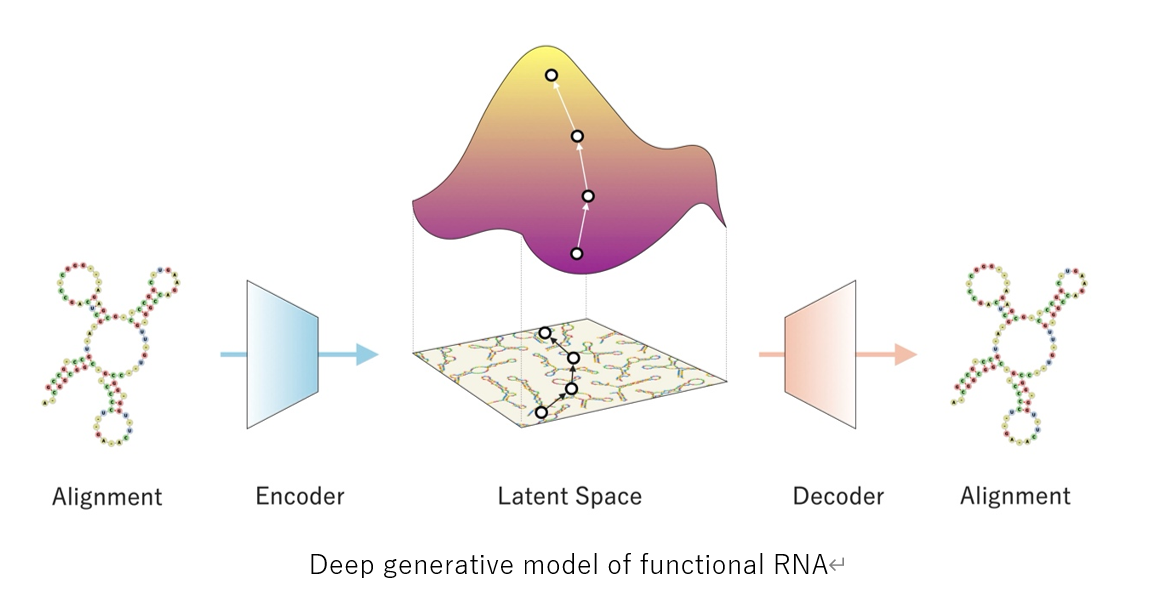
The research team aimed to avoid these problems by focusing on RNA families, which are sequence groups with thousands of functional RNAs endowed with identical functions. Even with only a few hundred sequences, multiple sequence alignment can create a consensus secondary structure from which new sequences can be generated. As this computational platform theoretically works with any functional RNA families, the researchers named their deep generative model the RNA family sequence Generator, or RfamGen, which is the world’s first deep generative model for functional RNA design.

RfamGen combines two approaches: (1) covariance model and (2) variational autoencoder. The covariance model is a type of statistical framework for RNA alignment and consensus secondary structure that quantitatively evaluates variations of sequence and structure. Meanwhile, the variational autoencoder is a deep generative model with an internal representation called “latent space” to mitigate the complexity associated with exploring the exponentially vast sequence space for the optimization of RNA sequences. By leveraging these two concepts, the researchers generated a system that learns sequence and structural information to explore new RNA designs logically, a feat that has never been done previously.

The team first compared RfamGen, which considers both alignment and secondary structural information, with models accounting for either alignment or secondary structural information, or neither.

For the 18 RNA families tested (each with alignments comprised of at least 10,000 sequences), RfamGen showed a significantly improved ability to generate high-quality RNA sequences. Furthermore, the researchers also tested RfamGen’s capabilities when restricted to a limited number of input sequences from which to learn. Despite only being trained on 500 input sequences, RfamGen successfully generated RNA sequences with high scores, thus demonstrating its efficient generative capacity.

The researchers next trained RfamGen using 629 RNA families in total, each with at least 100 sequences from the Rfam database, and found RfamGen performs substantially better compared to other systems. The researchers, furthermore, evaluated how well generated RNA sequences function by randomly synthesizing several RNA sequences generated from training it with a diversity of self-cleavage ribozymes and from random sampling a covariance model. Notably, the sequences generated by RfamGen showed enzymatic activity, while the randomly sampled sequences did not, indicating RfamGen learned important features essential for functionality from the training data.

Lastly, the research team utilized the ligand-dependent self-cleavage activity of the glmS ribozyme as a comparative platform to benchmark generated sequences by RfamGen to natural glmS sequences. They first trained RfamGen using about 500 natural glmS ribozyme sequences and sampled the “latent space” to obtain 1,000 generated sequences. Using a massively parallel assay, they tested these 1,000 generated sequences, 761 natural sequences in the glmS ribozyme family (RF00234), and 100 sequences with kinetic measurements from a previous report. Not only did the team observe the generated sequences to possess a similar distribution of cleavage kinetics as natural sequences, but remarkably found that generated sequences showed higher cleavage rates compared to natural sequences, thus suggesting RfamGen successfully generates high-quality sequences with comparable or higher efficiency than some natural sequences.

The golden age of RNA-based bioengineering is on the horizon. By constructing this deep generative model for functional RNA design, the research team believes RfamGen will be a fundamental driving force to propel RNA biology into a new era and enable discoveries and applications based on RNA.

Paper Details

Journal:

Nature Methods

Title:

Deep generative design of RNA family sequences

Authors:

Shunsuke Sumi1,2,3, Michiaki Hamada3,4,5,*, Hirohide Saito1,*
* : Corresponding authors

Author Affiliations:

  1. Center for iPS Cell Research and Application (CiRA), Kyoto University
  2. Graduate School of Medicine, Kyoto University
  3. Graduate School of Advanced Science and Engineering, Waseda University
  4. Computational Bio Big-Data Open Innovation Laboratory (CBBD-OIL), National Institute of Advanced Industrial Science and Technology (AIST)
  5. Graduate School of Medicine, Nippon Medical School

doi:

https://doi.org/10.1038/s41952-023-02148-8

Discovery of Structural Regularity Hidden in Silica Glass

著者: contributor
2023年11月25日 16:35

Discovery of Structural Regularity Hidden in Silica Glass

Glass – whether used to insulate our homes or as the screens in our computers and smartphones – is a fundamental material. Yet, despite its long usage throughout human history, the disordered structure of its atomic configuration still baffles scientists, making understanding and controlling its structural nature challenging. It also makes it difficult to design efficient functional materials made from glass.

To uncover more about the structural regularity hidden in glassy materials, a research group has focused on ring shapes in the chemically bonded networks of glass. The group, which included Professor Motoki Shiga from Tohoku University’s Unprecedented-scale Data Analytics Center, and Professor Akihiko Hirata from Waseda University created new ways in which to quantify the rings’ three-dimensional structure and structural symmetries: “roundness” and “roughness.”

Using these indicators enabled the group to determine the exact number of representative ring shapes in crystalline and glassy silica (SiO2), finding a mixture of rings unique to glass and ones that resembled the rings in the crystals.

Additionally, the researchers developed a technique to measure the spatial atomic densities around rings by determining the direction of each ring.

They revealed that there is anisotropy around the ring, i.e., that the regulation of the atomic configuration is not uniform in all directions, and that the structural ordering related to the ring-originated anisotropy is consistent with experimental evidence, like the diffraction data of SiO2. It was also revealed that there were specific areas where the atomic arrangement followed some degree of order or regularity, even though it appeared to be a discorded and chaotic arrangement of atoms in glassy silica.

“The structural unit and structural order beyond the chemical bond had long been assumed through experimental observations but its identification has eluded scientists until now,” says Shiga. “Furthermore, our successful analysis contributes to understanding phase-transitions, such as vitrification and crystallization of materials, and provides the mathematical descriptions necessary for controlling material structures and material properties.”

Looking ahead, Shiga and his colleagues will use these techniques to come up with procedures for exploring glass materials, procedures that are based on data-driven approaches like machine learning and AI.

Their findings were published open access in the journal Communication Materials on November 3, 2023.

<Publication Details>

Title: Ring-originated anisotropy of local structural ordering in amorphous and crystalline silicon dioxide
Authors: Motoki Shiga, Akihiko Hirata, Yohei Onodera, and Hirokazu Masai
Journal: Communications Materials
DOI: 10.1038/s43246-023-00416-w

Understanding the Dynamic Behavior of Rubber Materials

著者: contributor
2023年11月14日 14:12

Understanding the Dynamic Behavior of Rubber Materials

Researchers present a novel experimental system for simultaneous measurement of dynamic mechanical properties and X-ray computed tomography

Rubber-like materials can exhibit both spring-like and flow-like behaviors simultaneously, which contributes to their exceptional damping abilities. To understand the dynamic viscoelasticity of these materials, researchers from Japan have recently developed a novel system that can conduct dynamic mechanical analysis and dynamic micro X-ray computed tomography simultaneously. This technology can enhance our understanding of the microstructure of viscoelastic materials and pave the way for the development of better materials.

Experimental setup for the simultaneous measurement of dynamic mechanical properties and dynamic micro X-ray CT.

Rubber-like materials, commonly used in dampeners, possess a unique property known as dynamic viscoelasticity, enabling them to convert mechanical energy from vibrations into heat while exhibiting spring-like and flow-like behaviors simultaneously. Customization of these materials is possible by blending them with compounds of specific molecular structures, depending on the dynamic viscosity requirements.

However, the underlying mechanisms behind the distinct mechanical properties of these materials remain unclear. A primary reason for this knowledge gap has been the absence of a comprehensive system capable of simultaneously measuring the mechanical properties and observing the microstructural dynamics of these materials. While X-ray computed tomography (CT) has recently emerged as a promising option for a non-destructive inspection of the internal structure of materials down to nano-scale resolutions, it is not suited for observation under dynamic conditions.

Against this backdrop, a team of researchers, led by Associate Professor (tenure-track) Masami Matsubara from the School of Creative Science and Engineering at the Faculty of Engineering at Waseda University in Japan, has now developed an innovative system that can conduct dynamic mechanical analysis and dynamic micro X-ray CT imaging simultaneously. Their study was made available online on October 19, 2023 and will be published in Volume 205 of the journal Mechanical Systems and Signal Processing on December 15, 2023.

By integrating X-ray CT imaging performed at the large synchrotron radiation facility Spring-8(BL20XU) and mechanical analysis under dynamic conditions, we can elucidate the relationship between a material’s internal structure, its dynamic behavior, and its damping properties,” explains Dr. Matsubara. At the core of this novel system is the dynamic micro X-ray CT and a specially designed compact shaker developed by the team that is capable of precise adjustment of vibration amplitude and frequency.

The team utilized this innovative system to investigate the distinctions between styrene-butadiene rubber (SBR) and natural rubber (NR), as well as to explore how the shape and size of ZnO particles influence the dynamic behavior of SBR composites.

The researchers conducted dynamic micro X-ray CT scans on these materials, rotating them during imaging while simultaneously subjecting them to vibrations from the shaker. They then developed histograms of local strain amplitudes by utilizing the local strains extracted from the 3D reconstructed images of the materials’ internal structures. These histograms, in conjunction with the materials’ loss factor, a measure of the inherent damping of a material, were analyzed to understand their dynamic behavior.

When comparing materials SBR and NR, which have significantly different loss factors, the team found no discernible differences between their local strain amplitude histograms. However, the histograms displayed wider strain distributions in the presence of composite particles like ZnO. This suggests that strain within these materials is non-uniform and depends on the shape and size of the particles, which may have masked any changes from the addition of the particles.

This technology can allow us to study the microstructure of rubber and rubber-like materials under dynamic conditions and can result in the development of fuel-efficient rubber tires or gloves that do not deteriorate. Moreover, this technology can also enable the dynamic X-ray CT imaging of living organs that repeatedly deform, such as the heart, and can even pave the way for the development of artificial organs,” says Dr. Matsubara, highlighting the importance of this study.

Overall, this breakthrough technology has the potential to advance the understanding of the microstructure of viscoelastic materials, likely opening the doors for the development of novel materials with improved properties.

Reference

Authors Masami Matsubara1, Ryo Takara2, Taichi Komatsu2, Shogo Furuta2, Khoo Pei Loon2, Masakazu Kobayashi2, Hitomu Mushiaki3, Kentaro Uesugi4, Shozo Kawamura2, and Daiki Tajiri2
Title of original paper In-situ measurement of dynamic micro X-ray CT and dynamic mechanical analysis for rubber materials
Journal Mechanical Systems and Signal Processing
DOI 10.1016/j.ymssp.2023.110875
Affiliations 1Department of Modern Mechanical Engineering, Waseda University
2Department of Mechanical Engineering, Toyohashi University of Technology
3Hyogo Prefectural Institute of Technology
4Japan Synchrotron Radiation Research Institute

About Waseda University

Located in the heart of Tokyo, Waseda University is a leading private research university that has long been dedicated to academic excellence, innovative research, and civic engagement at both the local and global levels since 1882. The University has produced many changemakers in its history, including nine prime ministers and many leaders in business, science and technology, literature, sports, and film. Waseda has strong collaborations with overseas research institutions and is committed to advancing cutting-edge research and developing leaders who can contribute to the resolution of complex, global social issues. The University has set a target of achieving a zero-carbon campus by 2032, in line with the Sustainable Development Goals (SDGs) adopted by the United Nations in 2015.

To learn more about Waseda University, visit https://www.waseda.jp/top/en

About Associate Professor Masami Matsubara

Masami Matsubara is an Associate Professor (tenure-track) at the School of Creative Science and Engineering of the Faculty of Science and Engineering at Waseda University, Japan. He earned his Ph.D. from Doshisha University. His research focuses on the mechanics of materials, mechatronics, and dynamic modelling. He has recently worked on vibration reduction methods and dynamic design for large-scale numerical analysis models and detailed design and experimental methods for component and unit testing. He is a member of the Japan Society of Mechanical Engineers (JSME) and SAE International. He received the JSME Medal for Outstanding Paper in 2014, 2020, and 2022.

【PEP卓越大学院プログラム】2024年1月実施_7期生(2024年4月進入・編入)選抜試験(SE)情報更新しました_2023.09.27

著者: staff
2023年9月27日 12:36

文部科学省卓越大学院プログラム
「パワー・エネルギー・プロフェッショナル育成プログラム」
2024年1月実施の7期生(2024年進入・編入)選抜試験(SE)に関する情報更新致しました。

理工HP大学院入試ページの中のPEPSE情報ページ(募集要項・出願書類)
https://www.waseda.jp/fsci/admissions_gs/guidelines/pep/

Direct Power Generation from Methylcyclohexane Using Solid Oxide Fuel Cells

著者: contributor
2023年8月31日 09:35

Direct Power Generation from Methylcyclohexane Using Solid Oxide Fuel Cells

Researchers have successfully generated electricity directly from methylcyclohexane, an organic hydride, using solid oxide fuel cells, with lower energy than conventional catalytic dehydrogenation reactions.

Methylcyclohexane is very promising as a hydrogen carrier that can safely and efficiently transport and store hydrogen. However, the dehydrogenation process using catalysts has issues due to its durability and large energy loss. Recently, Japanese researchers have succeeded in using solid oxide fuel cells to generate electricity directly from methylcyclohexane and recover toluene for reuse. This research is expected to not only reduce energy requirements but also explore new chemical synthesis by fuel cells.

Caption: Solid oxide fuel cells can generate electricity directly from organic hydrides and have potential applications in chemical synthesis. Credit: Akihiko Fukunaga from Waseda University

Methylcyclohexane (MCH), a type of organic hydride, is expected to be an excellent hydrogen carrier because it remains liquid at room temperature, is easy to transport, has low toxicity, and has a higher hydrogen density than high-pressure hydrogen. Dehydrogenation—the process of removing hydrogen atoms from molecules—in the presence of a catalyst, yields hydrogen and the byproduct toluene, which can then be used to generate electricity to produce CO2-free power. However, the dehydrogenation reaction is an endothermic reaction, and energy loss as well as the facilities required for the reaction are issues.

Recently, a team of researchers from Japan, led by Professor Akihiko Fukunaga from the Department of Applied Chemistry at Waseda University, has succeeded in generating electricity directly from MCH using solid oxide fuel cells (SOFC). Their work was made available online on July 4, 2023 in Volume 348 of Applied Energy.

The research team tried to perform two processes simultaneously in a fuel cell: dehydrogenation from organic hydrides, which is an endothermic reaction, and electricity generation, which is an exothermic reaction. To achieve this, they used an anode-supported solid oxide fuel cell with a higher operating temperature than that of a polymer electrolyte fuel cell. They operated it at a temperature that did not allow pyrolysis of organic hydrides and under conditions that prevented carbon deposition at the electrodes. The production ratio of toluene to benzene was 94:6. This achievement demonstrated the possibility of generating electricity without using dehydrogenation facilities which were conventionally required and using less energy than that required for dehydrogenation reactions using catalysts.
In addition, “It was elucidated that by changing the conditions, oxygen groups could be introduced into the aromatic skeleton using a fuel cell” reveals Fukunaga.

These results indicate that the MHC reacts with the conducting oxygen ions in the SOFC to successfully generate electricity. Thus, power can be generated directly from MHC, and the energy required for direct power generation is lesser than that required for the conventional catalyst-assisted dehydrogenation reaction of MCH.

“Fuel cells have been studied and developed as devices that produce highly efficient, carbon-free electricity through the electrochemical reaction of hydrogen and oxygen. In this study, we have demonstrated that this device can be applied to control dehydrogenation reactions from organic hydrides and oxygen substitution reactions of aromatic rings. In the future, new synthetic chemistry may be created by applying fuel cells.” concludes Fukunaga. Here’s hoping that the proposed technology will pave the way to a sustainable hydrogen-based society!

Reference

Authors

Akihiko Fukunaga1, Asami Kato1, Yuki Hara1, and Takaya Matsumoto

Title of original paper

Dehydrogenation of Methylcyclohexane Using Solid Oxide Fuel Cell – A Smart Energy Conversion

Journal

Applied Energy

DOI

10.1016/j.apenergy.2023.121469

Affiliations

1 Department of Applied Chemistry, Waseda University

About Waseda University

Located in the heart of Tokyo, Waseda University is a leading private research university that has long been dedicated to academic excellence, innovative research, and civic engagement at both the local and global levels since 1882. The University has produced many changemakers in its history, including nine prime ministers and many leaders in business, science and technology, literature, sports, and film. Waseda has strong collaborations with overseas research institutions and is committed to advancing cutting-edge research and developing leaders who can contribute to the resolution of complex, global social issues. The University has set a target of achieving a zero-carbon campus by 2032, in line with the Sustainable Development Goals (SDGs) adopted by the United Nations in 2015.

To learn more about Waseda University, visit https://www.waseda.jp/top/en

About Professor Akihiko Fukunaga

Dr. Akihiko Fukunaga is a Faculty of Science and Engineering at the School of Advanced Science and Engineering at Waseda University in Japan. He received his Ph.D. from Waseda University in 1999 and has been a Professor of Applied Chemistry there since 2019. Prior to that, he worked at JXTG Nippon Oil & Energy Corporation from 1984 to 2019, where he successfully commercialized the residential fuel cell system, EneFarm. His research interests include energy materials, hydrogen, fuel cells, and carbon recycling.

❌