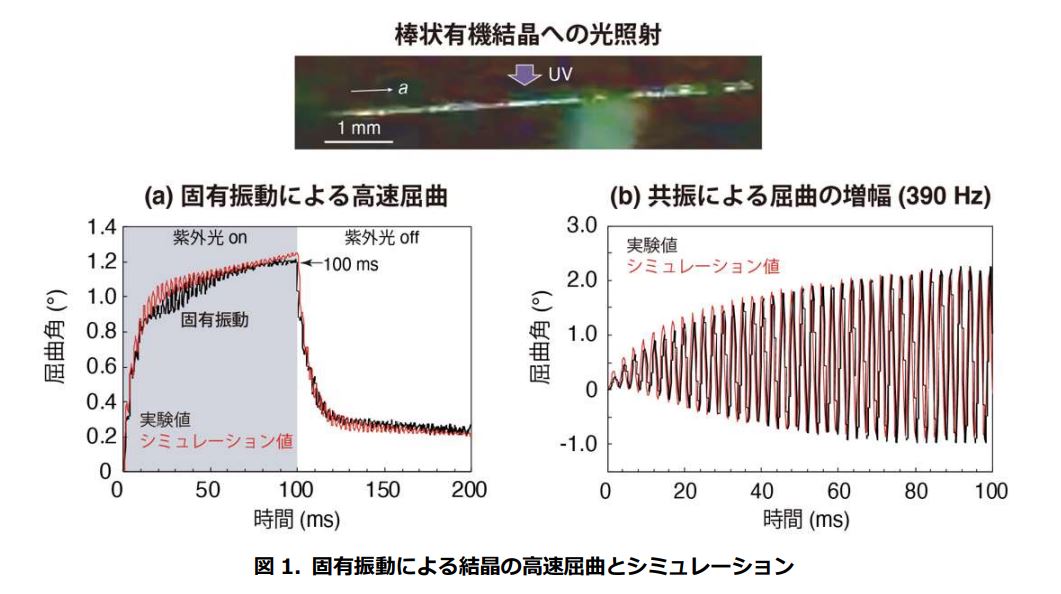
さらに、結晶の形状を変えると200–700 Hzの様々な共振固有振動が観察され、長く薄い結晶では「大きい屈曲」が、短く厚い結晶では「素早い屈曲」が創出できることがわかりました(図2a)。この共振固有振動について屈曲速度とエネルギー変換効率(光→屈曲運動)を、光異性化、光熱効果、非共振固有振動による屈曲と比較した結果、最も速い屈曲速度(0.2–0.7 m s-1)かつ最も高いエネルギー変換効率(~0.1 %)が得られることがわかりました(図2b)。
Researchers develop a four-wheeled, two orthogonal axes mechanism robot to maintain plants grown under solar panels
Synecoculture, a new farming method, involves growing mixed plant species together in high density. However, it requires complex operation since varying species with different growing seasons and growing speeds are planted on the same land. To address this need, researchers have developed a robot that can sow, prune, and harvest plants in dense vegetation grown. Its small, flexible body will help large-scale Synecoculture. This is an important step towards achieving sustainable farming and carbon neutrality.
Researchers have developed a small and flexible agricultural robot for Synecoculture farming. It has a four-wheel mechanism, two axes stand, robotic arm, camera unit, maneuvering system, and farming tools.
Synecoculture is a new agricultural method advocated by Dr. Masatoshi Funabashi, senior researcher at Sony Computer Science Laboratories, Inc. (Sony CSL), in which various kinds of plants are mixed and grown in high density, establishing rich biodiversity while benefiting from the self-organizing ability of the ecosystem. However, such dense vegetation requires frequent upkeep—seeds need to be sown, weeds need to be pruned, and crops need to be harvested. Synecoculture thus requires a high level of ecological literacy and complex decision-making. And while the operational issues present with Synecoculture can be addressed by using an agricultural robot, most existing robots can only automate one of the above three tasks in a simple farmland environment, thus falling short of the literacy and decision-making skills required of them to perform Synecoculture. Moreover, the robots may make unnecessary contact with the plants and damage them, affecting their growth and the harvest.
With the rising awareness of environmental issues, such a gap between the performance of humans versus that of conventional robots has spurred innovation to improve the latter.
A group of researchers led by Takuya Otani, an Assistant Professor at Waseda University, in collaboration with Sustainergy Company and Sony CSL, have designed a new robot that can perform Synecoculture effectively. The robot is called SynRobo, with “syn” conveying the meaning of “together with” humans. It manages a variety of mixed plants grown in the shade of solar panels, an otherwise unutilized space. An article describing their research was published in Volume 13, Issue 1 of Agriculture, on 21 December 2022. This article has been co-authored by Professor Atsuo Takanishi, also from Waseda University, other researchers of Sony CSL, and students from Waseda University.
Otani briefly explains the novel robot’s design. “It has a four-wheel mechanism that enables movement on uneven land and a robotic arm that expands and contracts to help overcome obstacles. The robot can move on slopes and avoid small steps. The system also utilizes a 360o camera to recognize and maneuver its surroundings. In addition, it is loaded with various farming tools—anchors (for punching holes), pruning scissors, and harvesting setups. The robot adjusts its position using the robotic arm and an orthogonal axes table that can move horizontally.”
Besides these inherent features, the researchers also invented techniques for efficient seeding. They coated seeds from different plants with soil to make equally-sized balls. These made their shape and size consistent, so that the robot could easily sow seeds from multiple plants. Furthermore, an easy-to-use, human-controlled maneuvering system was developed to facilitate the robot’s functionality. The system helps it operate tools, implement automatic sowing, and switch tasks.
The new robot could successfully sow, prune, and harvest in dense vegetation, making minimal contact with the environment during the tasks because of its small and flexible body. In addition, the new maneuvering system enabled the robot to avoid obstacles 50% better while reducing its operating time by 49%, compared to a simple controller.
“This research has developed an agricultural robot that works in environments where multiple species of plants grow in dense mixtures,” Otani tells us. “It can be widely used in general agriculture as well as Synecoculture—only the tools need to be changed when working with different plants. This robot will contribute to improving the yield per unit area and increase farming efficiency. Moreover, its agricultural operation data will help automate the maneuvering system. As a result, robots could assist agriculture in a plethora of environments. In fact, Sustainergy Company is currently preparing to commercialize this innovation in abandoned fields in Japan and desertified areas in Kenya, among other places.”
Such advancements will promote Synecoculture farming, with the combination of renewable energy, and help solve various pressing problems, including climate change and the energy crisis. The present research is a crucial step toward achieving sustainable agriculture and carbon neutrality. Here’s hoping for a smart and skillful robot that efficiently supports large-scale Synecoculture!
This robot successfully sows, prunes, and harvests complex vegetation grown in the shade of solar panels. Its maneuvering system reduces operation time by 49%.
Reference
Authors:Takuya Otani1, Akira Itoh2, Hideki Mizukami2, Masatsugu Murakami2, Shunya Yoshida2, Kota Terae2, Taiga Tanaka2, Koki Masaya2, Shuntaro Aotake2,3, Masatoshi Funabashi3, and Atsuo Takanishi2
About Professor Takuya Otani from Waseda Research Institute for Science and Engineering
Takuya Otani is an Assistant Professor at the Faculty of Science and Engineering at Waseda Research Institute for Science and Engineering. He received his Ph.D. degree from Waseda University in 2016. He is a member of the Virtual Reality Society of Japan, Japanese Council of IFToMM, Japan Society of Mechanical Engineers, Robotics Society of Japan, and IEEE. He received the Waseda e-Teaching Good Practice Award in 2021. His research interests include robotics and intelligent system, intelligent robotics, haptics, humanoid robotics, and mechanics and mechatronics. His recent work involves developing efficient robots for Synecoculture agriculture.
About Waseda University
Located in the heart of Tokyo, Waseda University is a leading private research university that has long been dedicated to academic excellence, innovative research, and civic engagement at both the local and global levels since 1882. The University has produced many changemakers in its history, including nine prime ministers and many leaders in business, science and technology, literature, sports, and film. Waseda has strong collaborations with overseas research institutions and is committed to advancing cutting-edge research and developing leaders who can contribute to the resolution of complex, global social issues. The University has set a target of achieving a zero-carbon campus by 2032, in line with the Sustainable Development Goals (SDGs) adopted by the United Nations in 2015.
Synecoculture is a method of farming that produces useful plants while making multifaceted use of the self-organizing ability of the earth’s ecosystem. Advocated by Dr. Masatoshi Funabashi of Sony Computer Science Laboratories, Inc., it is characterized by a comprehensive ecosystem utilization method that considers not only food production but also the impacts on the environment and health.
*”Synecoculture” is a registered trademark or a trademark of Sony Group Corporation.
About Sustainergy Company
Sustainergy Company, a Tokyo-based renewable-energy startup, its management philosophy is “making the world sustainable through energy”, has been developing and operating solar power generation projects in Japan, including large-scale farm-based solar power generation (Agrivoltaics). The company noticed that the space under the solar panels of many solar power plants is underutilized and thought that if Sony CSL’s Synecoculture farming method could be applied to the semi-shaded area under the solar panels, the degraded soil could be restored, and the land could be turned into greenery and farmland, thereby enabling both food production and renewable energy production on the same land. Sustainergy Company is preparing to commercialize this project in abandoned farmlands in Japan, desertified areas in Kenya, and other countries. To learn more about Sustainergy Company, visit https://sustainergy.co.jp/.
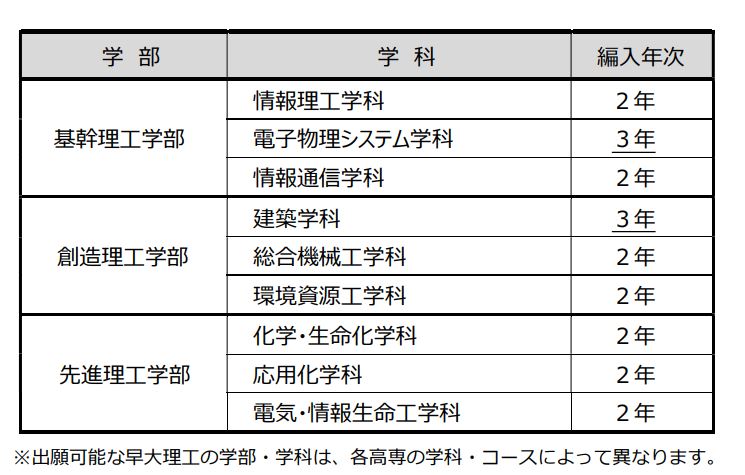
a. 推薦依頼のあった高等専門学校の学科・コースに在籍し、2024年3月に高等専門学校(本科)を卒業見込の者。
b. 推薦を依頼する早大理工の学部・学科への入学を第一志望とする者。
c. 入学後の勉学に関して明確な志向と意欲を持ち、それにふさわしい能力を備えた者。
d. 出願開始日から起算して、過去2年以内に受験したTOEFL-iBT(TOEFL-ITPは不可)、
IELTS(Academic Module)、TOEIC(IP、Speaking & Writingは不可)の内いずれかのスコアを出願期間内に提出可能な者。
e. 学業成績において、次の基準を満たす者。
① 4年次の学年の学科現員に対する学業成績の席次が、上位10%以内の者
② 席次を定めない高等専門学校では、在籍学校長が①と同等と認めて推薦する者
Researchers successfully record the phase distribution of electrons, unveiling the detailed structure of its complex wavefunction
The structure, dynamics, and functions of materials are predominantly determined by their constituent electrons. Owing to their quantum nature, electrons have “wave”-like characteristics. However, measuring the phase of an electron and its complex electron wavefunction is challenging. Using state-of-the-art attosecond technology, researchers at Waseda University and National Research Council of Canada have now successfully recorded the phase distribution of electrons ejected from a neon atom, allowing a complete, detailed visualization of the complex electron wavefunction.
The early 20th century saw the advent of quantum mechanics to describe the properties of small particles, such as electrons or atoms. Schrödinger’s equation in quantum mechanics can successfully predict the electronic structure of atoms or molecules. However, the “duality” of matter, referring to the dual “particle” and “wave” nature of electrons, remained a controversial issue. Physicists use a complex wavefunction to represent the wave nature of an electron. “Complex” numbers are those that have both “real” and “imaginary” parts—the ratio of which is referred to as the “phase”. However, all directly measurable quantities must be “real”. This leads to the following challenge: when the electron hits a detector, the “complex” phase information of the wavefunction disappears, leaving only the square of the amplitude of the wavefunction (a “real” value) to be recorded. This means that electrons are detected only as particles, which makes it difficult to explain their dual properties in atoms.
The ensuing century witnessed a new, evolving era of physics, namely, attosecond physics. The attosecond is a very short time scale, a billionth of a billionth of a second. “Attosecond physics opens a way to measure the phase of electrons. Achieving attosecond time-resolution, electron dynamics can be observed while freezing molecular motion,” explains Professor Hiromichi Niikura from the Department of Applied Physics, Waseda University, Japan, who, along with Professor D. M. Villeneuve—a principal research scientist at the Joint Attosecond Science Laboratory, National Research Council, and adjunct professor at University of Ottawa—pioneered the field of attosecond physics. Niikura and Villeneuve had previously developed a breakthrough method, attosecond re-collision, and also demonstrated the imaging of a molecular orbital or electron wavefunction in a molecule.
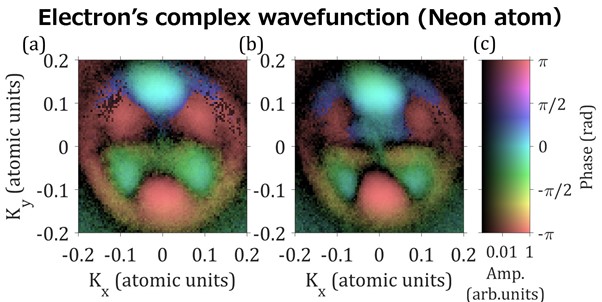
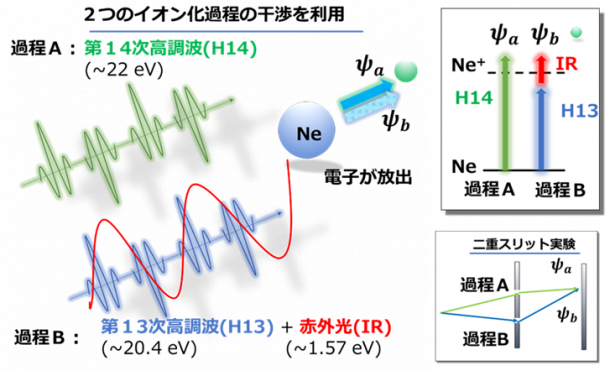
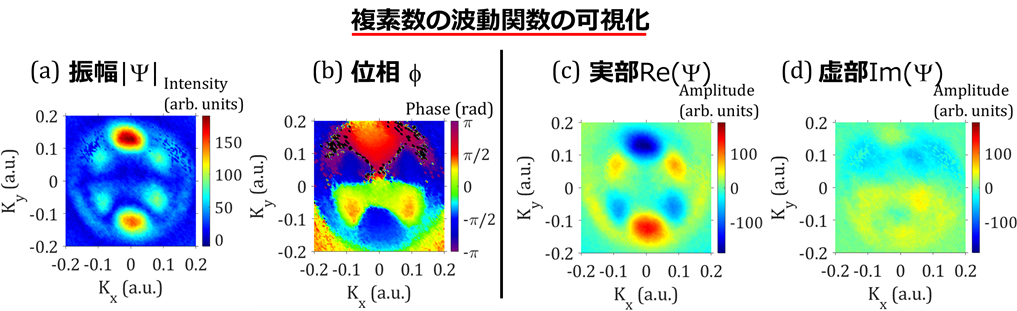
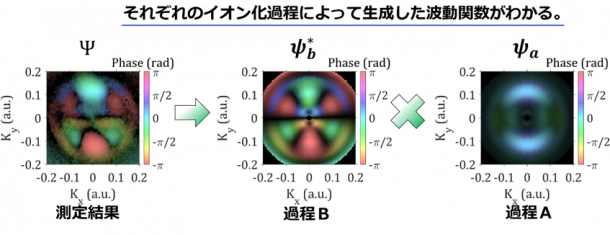
In a recent study published in Volume 106 Issue 6 (2022; page 063513) of Physical Review A on 23 December, 2022, these researchers employed another approach involving attosecond physics, using an attosecond laser pulse, or high-harmonic generation, to visualize a complex wavefunction. The attosecond laser pulse consists of coherent light with a wavelength much shorter than ultra-violet, referred to as extreme ultra-violet (EUV) light. When this pulse irradiates a gas, an electron is ejected. This process is referred to as photoionization. The attosecond pulse consists of a set of “harmonics” or different colors of light. By controlling the generation of the attosecond pulse, the researchers isolated two photoionization pathways—one consisting of a particular harmonic, and the other consisting of another harmonic along with an infrared pulse—to ionize neon. The electron wavefunctions produced by both pathways can interfere with each other. The interference pattern varies with the attosecond delay between the harmonics and the IR pulses. The team determined the phase and amplitude distributions of the photoelectron from the interference pattern and visualized its complex wavefunction. As the energy resolution is smaller than the bandwidth of the attosecond pulses, the researchers were successful in visualizing the detailed wavefunction structure. Furthermore, the researchers developed a method of disentangling the measured wavefunction into wavefunctions that are produced by individual ionization pathways.
Now that the researchers have successfully visualized the complex wavefunction of an electron—something that cannot be seen through conventional photoelectron spectroscopy—there’s so much more they can achieve! Niikura says, “Nowadays, photoelectron spectroscopy using EUV and X-ray has become a basic tool for investigating structures and dynamics of materials. The present method will provide a way to elucidate the quantum properties of electrons.” Visualizing the complete, detailed, complex electron wavefunction will be of significant impact in the fields of nanotechnology, chemistry, and molecular biology.
Image title: Visualizing complex photoelectron wavefunctions using attosecond imaging technology
Image caption: Researchers measure the phase and amplitude of the complex electron wavefunctions (a,b), represented by color (or hue) for phase and brightness (or value) for amplitude (plotted in logarithmic scale), in the hue-saturation-value (HSV) color map, as shown in (c).
Image credits: Hiromichi Niikura from Waseda University
License type: Original content
Hiromichi Niikura is a Professor at the Department of Applied Physics, Waseda University. He obtained his bachelors from Kyoto Institute of Technology, masters from Graduate School of Kyoto Institute of Technology, and Ph.D. from Graduate University for Advanced Studies, Institute for Molecular Science, Japan. His research focuses on atomic, molecular, and optical (AMO) physics. He has worked at National Research Council of Canada (2000-2009), where he conducted a pioneering work in attosecond physics, a new emerging field. Niikura was awarded the prestigious Japan Society for Promotion of Science (JSPS) award in 2012. Professor Niikura can be contacted at [email protected].
早稲田大学理工学術院の新倉 弘倫(にいくら ひろみち)教授らは、カナダ国立研究機構のD. M. Villeneuve博士と共同で、アト秒レーザーによりネオン原子から放出された電子の波動関数※1を、位相分布も含めて高分解能で可視化する方法を開発しました。電子の「位相」と「振幅」がどのように分布しているのかがわかることで、「複素数」の電子波動関数を可視化することができます。本研究により、様々な物質の構造や機能がどのように発現しているのかを、波動関数の観点から解き明かすことが期待されます。
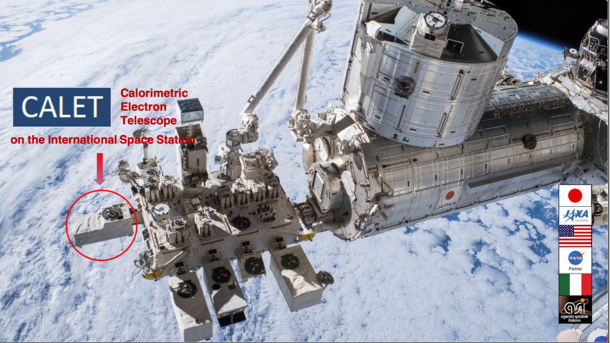
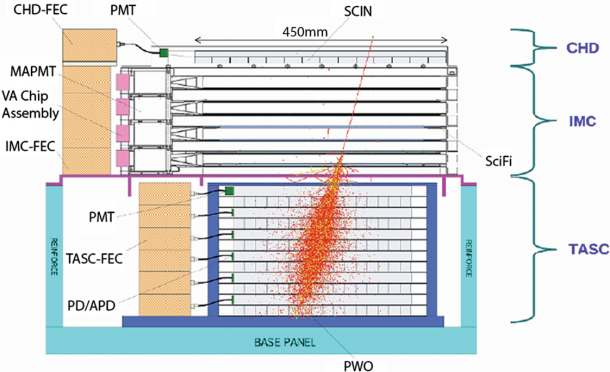
CALorimetric Electron Telescope(CALET)はカロリメータ方式の宇宙線電子望遠鏡で、日本の宇宙線観測としては初めての本格的な宇宙実験です。高エネルギー電子の高精度観測に最適化されたユニークな装置となっています。CALETの主となる検出装置は「カロリメータ」と言い、ここに飛び込んでくる宇宙線を捉えて観測することになります。カロリメータは、図3のように3つの層からできています。図3の第1の層(CHD)では粒子の電荷を測定し、原子番号を調べます。第2の層(IMC)では、粒子が飛んできた方向を測定します。そしてもっとも厚みのある第3の層(TASC)で、宇宙線が吸収されて生じる「シャワー」の発達の様子からその宇宙線のエネルギーや種類を特定します。この3つの層から得られる情報を統合することで、その宇宙線について知るべきことがほとんどわかります。特に第三の層の厚さや使われている物質によって、どれだけ高いエネルギーの粒子まで観測することができるかが決まるのですが、CALETはとりわけここが従来の観測装置に比べて高い性能を持っています。
Discovering Rare Red Spiral Galaxy Population from Early Universe with the James Webb Space Telescope
The first image of NASA’s James Webb Space Telescope reveals a detailed morphology of highly redshifted spiral galaxies
Morphology of galaxies contain important information about the process of galaxy formation and evolution. With its state-of-the-art resolution, NASA’s James Webb Space Telescope has now captured several red spiral galaxies in its first image at an unprecedented resolution. Researchers from Waseda University have now analyzed these galaxies, revealing that these are among the furthest known spiral galaxies till date. The analysis further detected a passive red spiral galaxy in the early universe, a surprising discovery.
Spiral galaxies represent one of the most spectacular features in our universe. Among them, spiral galaxies in the distant universe contain significant information about their origin and evolution. However, we have had a limited understanding of these galaxies due to them being too distant to study in detail. “While these galaxies were already detected among the previous observations using NASA’s Hubble Space Telescope and Spitzer Space Telescope, their limited spatial resolution and/or sensitivity did not allow us to study their detailed shapes and properties,” explains Junior Researcher Yoshinobu Fudamoto from Waseda University in Japan, who has been researching galaxies’ evolution.
Now, NASA’s James Webb Space Telescope (JWST) has taken things to the next level. In its very first imaging of the galaxy cluster, SMACS J0723.3-7327, JWST has managed to capture infrared images of a population of red spiral galaxies at an unprecedented resolution, revealing their morphology in detail!
Against this backdrop, in a recent article published in The Astrophysical Journal Letters on 21 October 2022, a team of researchers comprising Junior Researcher Yoshinobu Fudamoto, Prof. Akio K. Inoue, and Dr. Yuma Sugahara from Waseda University, Japan, has revealed surprising insights into these red spiral galaxies. Among the several red spiral galaxies detected, the researchers focused on the two most extremely red galaxies, RS13 and RS14. Using spectral energy distribution (SED) analysis, the researchers measured the distribution of energy over wide wavelength range for these galaxies. The SED analysis revealed that these red spiral galaxies belong to the early universe from a period known as the “cosmic noon” (8-10 billion years ago), which followed the Big Bang and the “cosmic dawn.” Remarkably, these are among the farthest known spiral galaxies till date.
Rare, red spiral galaxies account for only 2% of the galaxies in the local universe. This discovery of red spiral galaxies in the early universe, from the JWST observation covering only an insignificant fraction of space, suggests that such spiral galaxies existed in large numbers in the early universe.
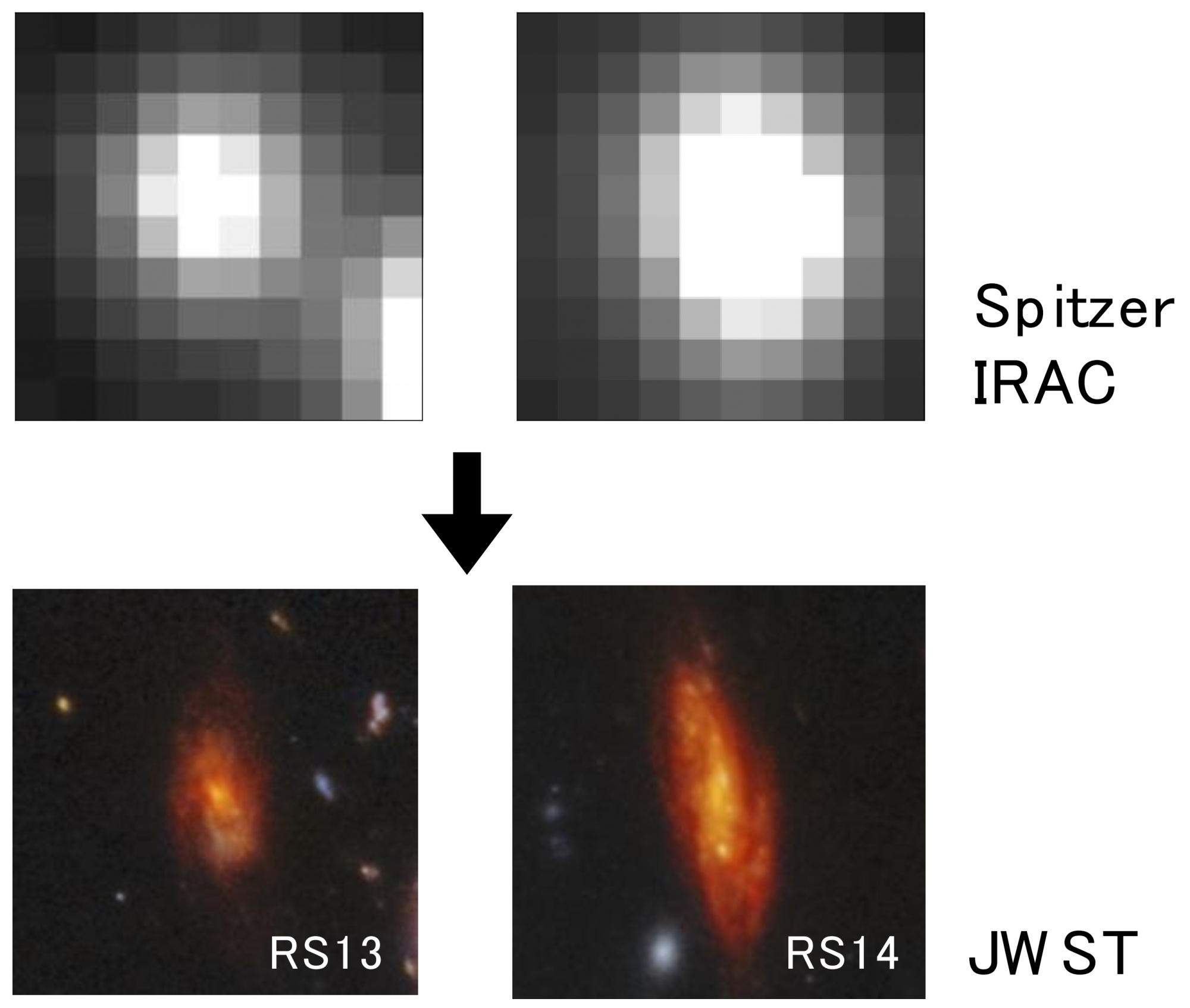
As a remarkable improvement over previous IRAC image (above), JWST’s unprecedented spatial resolution and high IR sensitivity reveals the morphological details of the red spiral galaxies (below) RS13 and RS14. This facilitates a detailed analysis revealing hitherto unknown features of red spiral galaxies belonging to the early universe.
The researchers further discovered that one of the red spiral galaxies, RS14, is a “passive” (not forming stars) spiral galaxy, contrary to the intuitive expectation that galaxies in the early universe would be actively forming stars. This detection of a passive spiral galaxy in the JWST’s limited field of view is particularly surprising, since it suggests that such passive spiral galaxies could also exist in large numbers in the early universe.
Overall, the findings of this study significantly enhances our knowledge about red spiral galaxies, and the universe as a whole. “Our study showed for the first time that passive spiral galaxies could be abundant in the early universe. While this paper is a pilot study about spiral galaxies in the early universe, confirming and expanding upon this study would largely influence our understanding of the formation and evolution of galactic morphologies,” concludes Fudamoto.
Reference
Title of original paper: Red Spiral Galaxies at Cosmic Noon Unveiled in the First JWST Image
DOI: 10.3847/2041-8213/ac982b
Journal: The Astrophysical Journal Letters Article Publication Date: October 21, 2022 Authors: Yoshinobu Fudamoto1,2, Akio K. Inoue1,3, and Yuma Sugahara1,2 Affiliations: 1Waseda Research Institute for Science and Engineering, Faculty of Science and Engineering, Waseda University 2National Astronomical Observatory of Japan 3Department of Physics, School of Advanced Science and Engineering, Faculty of Science and Engineering, Waseda University
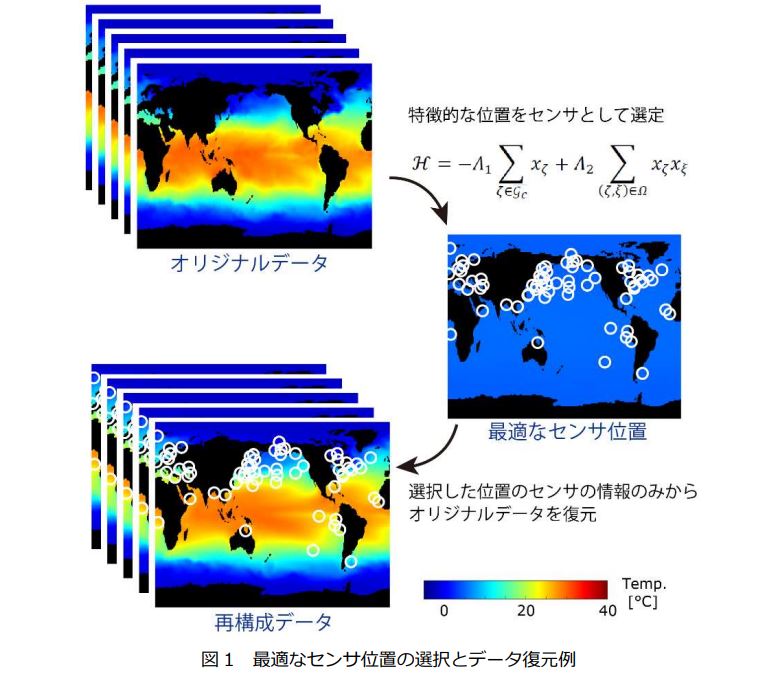
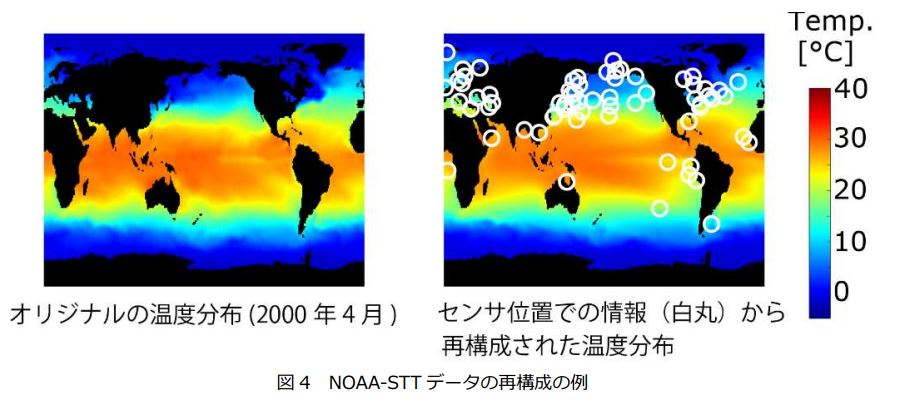
本研究では、提案した手法によって得られた解の妥当性を評価するために、NOAA-STTデータ(National Oceanic and Atmospheric Administration(アメリカ海洋大気庁)の提供している海水面温度変化データ)を用いた精度検証を行いました。これにより従来法と遜色なく少数の点での温度データのみから元の海水面温度分布を再現できることを示しました(図4)。

 ログイン
ログイン