 ログイン
ログイン
【PEP卓越大学院プログラム】2022年1-2月実施 選抜試験(2022年4月進入・編入)情報更新しました。
【PEP卓越大学院プログラム】
2022年1-2月実施選抜試験(2022年4月進入・編入)募集要項 更新しました。
以下の大学院入試ページ
文部科学省卓越大学院プログラム「パワー・エネルギー・プロフェッショナル育成プログラム(PEP)
からご確認ください。

【PEP卓越大学院プログラム】
2022年1-2月実施選抜試験(2022年4月進入・編入)募集要項 更新しました。
以下の大学院入試ページ
文部科学省卓越大学院プログラム「パワー・エネルギー・プロフェッショナル育成プログラム(PEP)
からご確認ください。
演題:トポロジーに登場する数式
日時:2021年11月24日(水)14:00-18:00
会場:オンライン配信
講師:佐藤 淳
(東京大学 大学院 新領域創成科学研究科 社会文化環境学専攻 准教授)
対象:学部生・大学院生、教職員、学外者、一般の方
参加方法:参加ご希望の方は開催時刻になりましたら下記URLより入室して下さい。
https://au.bbcollab.com/guest/41ec424f9db34a5a9c45e93abb6e1ffd
主催:創造理工学部 建築学科
問合せ:早稲田大学 理工センター 総務課
TEL:03-5286-3000
文部科学省卓越大学院プログラム
「パワー・エネルギー・プロフェッショナル(PEP)育成プログラム」
5期生(2022年4月進入・編入)募集説明会
<日時>
2021年12月8日(水)12:15-12:50
<形式>
Zoomミーティングによるオンライン形式
申請フォームより参加登録いただいた方にURL等詳細をメールでお送りいたします。
<申込>
https://bit.ly/3b8UTZt
申込締切:12月8日(水)10:00まで
<問合せ>
PEP卓越大学院プログラム事務局 ℡:03-5286-3238
email:[email protected]
Parents’ Day for this Academic Year (Academic Year 2021) will be taken place online from 9:00AM on November 6 (Sat.) to 12:00PM on November 15 (Mon.).(*)※1
Each department at School of Fundamental/Creative/Advanced Science and Engineering will introduce its English-based Undergraduate Program (Major).※2
*1: This website is available only during the Parents’ Day.
*2: Departments which are not on this website do not conduct the Parents’ Day in this academic year.
Note: Each material on this page has a watermark on the background to prevent diversion of the material.
TOGAWA, Nozomu
Dean, School/Graduate School of Fundamental Science and Engineering
Features and initiatives of School of Fundamental Science and Engineering (Click the image below)
| Major | Introductory Material | Contact information (Please change [at] to @.) |
|---|---|---|
| Major in Mathematical Sciences | Mail:bowen[at]waseda.jp sadayosi[at]aoni.waseda.jp kazunaga[at]waseda.jp |
|
| Major in Computer Science and Communications Engineering | Mail:csce-mentor2021[at]cs.waseda.ac.jp |
ARIGA, Takashi
Dean, School/Graduate School of Creative Science and Engineering
Please refer to English script.
Features and initiatives of School of Creative Science and Engineering (Click the image below)
| Major | Introductory Material | Contact information (Please change [at] to @.) |
|---|---|---|
| Major in Civil and Environmental Engineering | Please refer to the Civil and Environmental Eng.in the List of Class Academic Advisors. |
KANOMATA, Nobuhiro
Dean, School/Graduate School of Advanced Science and Engineering
Features and initiatives of School of Advanced Science and Engineering (Click the image below)
| Major | Introductory Material | Contact information (Please change [at] to @.) |
|---|---|---|
| Major in Physics | Mail:parentsday2021-physics[at]list.waseda.jp | |
| Major in Chemistry | Please refer to the Chemistry Eng.in the List of Class Academic Advisors. | |
| Major in Bioscience | Please refer to the Bioscience Eng.in the List of Class Academic Advisors. |
演題:建築の詩的な叙事
日時:2021年12月16日(木)16:30-18:00
会場:Zoomによるオンライン講演会
講師:王 欣 (中国美術学院 准教授、雑誌『烏有園』編集長)
対象:学部生・大学院生、教職員、学外者、一般の方
参加方法:参加ご希望の方は開催時刻になりましたら下記URLより入室して下さい。
https://zoom.us/j/98486838632?pwd=U0UybEsrWGFFWEptaDFOempDS09QUT09
主催:創造理工学部 建築学科
問合せ:早稲田大学 理工センター 総務課
TEL:03-5286-3000
演題:吸着技術の理解と応用
日時:
第1回 2021年11月15日(月)10:40-12:10
第2回 2021年11月22日(月)10:40-12:10
第3回 2021年11月29日(月)10:40-12:10
会場:Zoomによるオンライン講演会(後日URLをお送りいたします)
講師:望月 和博
(工学博士 合同会社リトカ研究者工房 社長/代表社員)
対象:学部生、大学院生、教職員、一般の方
参加方法:参加無料、事前申込制
事前申込先:https://forms.gle/texMP7uxGLwLr7t69
上記URL入力フォームにて、「メールアドレス」「氏名」「所属」「講演会参加の目的」「参加回」「学籍番号(早稲田大学学生のみ)」を入力してお申し込み下さい。
申込締切:2021年11月10日(水)15:00
主催:創造理工学部 環境資源工学科
演題:数学で知る健康と健康予報
日時:2021年10月28日(木)16:30-18:00
会場:Zoomによるオンライン講演会
講師:中岡 慎治
(北海道大学先端生命科学研究院准教授)
対象:学部生、大学院生、教職員、学外者、一般の方
参加方法:参加無料、事前申込制
事前申込先:[email protected]
「お名前」「所属」「メールアドレス」「講演会参加の目的」を明記下さい。
早稲田大学の学生の場合は、学籍番号もご記入ください。
申し込みいただいた方に、zoomアドレスをお送りします。
主催:先進理工学部 生命医科学科
問合せ:早稲田大学 理工センター 総務課
TEL:03-5286-3000
演題:Properties, application, and recycling methods of polymeric materials
日時:2021年10月14日(木)9:00-10:30
使用言語:英語による講演、質疑応答
会場:Zoomによるオンライン講演会(後日URLをお送りいたします)
講師:Oleszek Sylwia Izabela
(京都大学 大学院 工学研究科 都市環境工学専攻 博士研究員)
対象:学部生、大学院生、教職員、一般の方
参加方法:参加無料、事前申込制
事前申込先:https://forms.gle/gTY5UuUwph3Yq2Ya9
上記URL入力フォームにて、「メールアドレス」「氏名」「所属」「講演会参加の目的」
「学籍番号(早稲田大学学生のみ)」を入力してお申し込み下さい。
申込締切:2021年10月8日(金)15:00
主催:創造理工学部 環境資源工学科
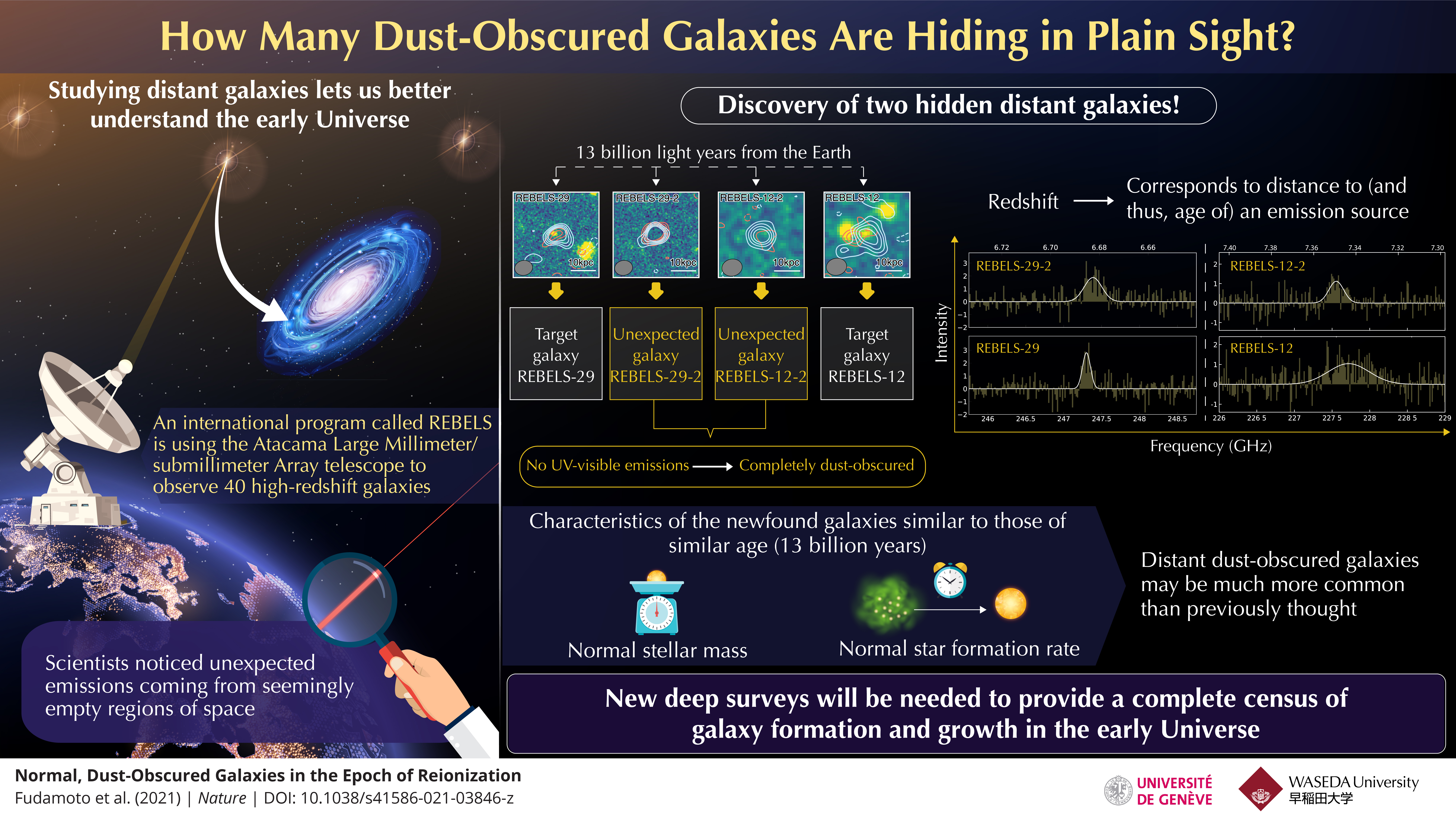
While investigating the data of young, distant galaxies observed with the Atacama Large Millimeter/submillimeter Array, Dr. Yoshinobu Fudamoto from Waseda University and the National Astronomical Observatory of Japan noticed unexpected emissions coming from seemingly empty regions in space that, a global research team confirmed, came actually from two hitherto undiscovered galaxies heavily obscured by cosmic dust. This discovery suggests that numerous such galaxies might still be hidden in the early Universe, many more than researchers were expecting.

A schematic of the results of this research. ALMA revealed a hitherto undiscovered galaxy as it is buried deep in dust (artist’s impression in upper right) in a region where the Hubble Space Telescope could not see anything (left). Researchers serendipitously discovered the new hidden galaxy while observing an already well-known typical young galaxy (artist’s impression in lower right)
Credit: ALMA (ESO/NAOJ/NRAO), NASA/ESA Hubble Space Telescope
When astronomers peer deep into the night sky, they observe what the Universe looked like a long time ago. Because the speed of light is finite, studying the most distant observable galaxies allows us to glimpse billions of years into the past when the Universe was very young and galaxies had just started to form stars. Studying this “early Universe” is one of the last frontiers in astronomy and is essential for constructing accurate and consistent astrophysics models. A key goal of scientists is to identify all the galaxies in the first billion years of cosmic history and to measure the rate at which galaxies were growing by forming new stars.
Various efforts have been made over the past decades to observe distant galaxies, which are characterized by electromagnetic emissions that become strongly redshifted (shifted towards longer wavelengths) before reaching the Earth. So far, our knowledge of early galaxies has mostly relied on observations with the Hubble Space Telescope (HST) and large ground-based telescopes, which probe their ultra-violet (UV) emission. However, recently, astronomers have started to use the unique capability of the Atacama Large Millimeter/submillimeter Array (ALMA) telescope to study distant galaxies at submillimeter wavelengths. This could be particularly useful for studying dusty galaxies missed in the HST surveys due to the dust absorbing UV emission. Since ALMA observes in submillimeter wavelengths, it can detect these galaxies by observing the dust emissions instead.
In an ongoing large program called REBELS (Reionization-Era Bright Emission Line Survey), astronomers are using ALMA to observe the emissions of 40 target galaxies at cosmic dawn. Using this dataset, they have recently discovered that the regions around some of these galaxies contain more than meets the eye.
While analyzing the observed data for two REBELS galaxies, Dr. Yoshinobu Fudamoto of the Research Institute for Science and Engineering at Waseda University, Japan, and the National Astronomical Observatory of Japan (NAOJ), noticed strong emission by dust and singly ionized carbon in positions substantially offset from the initial targets. To his surprise, even highly sensitive equipment like the HST couldn’t detect any UV emission from these locations. To understand these mysterious signals, Fudamoto and his colleagues investigated matters further.
In their latest paper published in Nature, they presented a thorough analysis, revealing that these unexpected emissions came from two previously unknown galaxies located near the two original REBELS targets. These galaxies are not visible in the UV or visible wavelengths as they are almost completely obscured by cosmic dust. One of them represents the most distant dust-obscured galaxy discovered so far.

Distant galaxies imaged with ALMA, the Hubble Space Telescope, and the European Southern Observatory’s VISTA telescope. Green and orange colors represent radiations from ionized carbon atoms and dust particles, respectively, observed with ALMA, and blue represents near-infrared radiation observed with VISTA and Hubble Space Telescopes.
REBELS-12 and REBELS-29 detected both near-infrared radiation and radiation from ionized carbon atoms and dust. On the other hand, REBELS-12-2 and REBELS-29-2 have not been detected in the near-infrared, which suggests that these galaxies are deeply buried in dust.
Credit: ALMA (ESO/NAOJ/NRAO), NASA/ESA Hubble Space Telescope, ESO, Fudamoto et al.
What is most surprising about this serendipitous finding is that the newly discovered galaxies, which formed more than 13 billion years ago, are not strange at all when compared with typical galaxies at the same epoch. “These new galaxies were missed not because they are extremely rare, but only because they are completely dust-obscured,” explains Fudamoto. However, it is uncommon to find such “dusty” galaxies in the early period of the Universe (less than 1 billion years after the Big Bang), suggesting that the current census of early galaxy formation is most likely incomplete, and would call for deeper, blind surveys. “It is possible that we have been missing up to one out of every five galaxies in the early Universe so far,” Fudamoto adds.
The researchers expect that the unprecedented capability of the James Webb Space Telescope (JWST) and its strong synergy with ALMA would lead to significant advances in this field in the coming years. “Completing our census of early galaxies with the currently missing dust-obscured galaxies, like the ones we found this time, will be one of the main objectives of JWST and ALMA surveys in the near future,” states Pascal Oesch from University of Geneva.
Overall, this study constitutes an important step in uncovering when the very first galaxies started to form in the early Universe, which in turn shall help us understand where we are standing today.
Authors: Y. Fudamoto1,2,3, P. A. Oesch1,4, S. Schouws5, M. Stefanon5, R. Smit6, R. J. Bouwens5, R. A. A. Bowler7, R. Endsley8, V. Gonzalez9,10, H. Inami11, I. Labbe12, D. Stark8, M. Aravena13, L. Barrufet1, E. da Cunha14,15, P. Dayal16, A. Ferrara17, L. Graziani18,20, 27, J. Hodge5, A. Hutter16, Y. Li21,22, I. De Looze23,24, T. Nanayakkara12, A. Pallottini17, D. Riechers25, R. Schneider18,19,26,27, G. Ucci16, P. van der Werf5, C. White8
Title of original paper: Normal, Dust-Obscured Galaxies in the Epoch of Reionization
Journal: Nature
DOI: 10.1038/s41586-021-03846-z
Affiliations:
1Department of Astronomy, University of Geneva
2Research Institute for Science and Engineering, Waseda University; 3National Astronomical Observatory of Japan
4Cosmic Dawn Center (DAWN), Niels Bohr Institute, University of Copenhagen
5Leiden Observatory, Leiden University
6Astrophysics Research Institute, Liverpool John Moores University
7Sub-department of Astrophysics, The Denys Wilkinson Building, University of Oxford
8Steward Observatory, University of Arizona
9Departmento de Astronomia, Universidad de Chile
10Centro de Astrofisica y Tecnologias Afines (CATA)
11Hiroshima Astrophysical Science Center, Hiroshima University
12Centre for Astrophysics & Supercomputing, Swinburne University of Technology
13Nucleo de Astronomia, Facultad de Ingenieria y Ciencias, Universidad Diego Portales
14International Centre for Radio Astronomy Research, University of Western Australia
15ARC Centre of Excellence for All Sky Astrophysics in 3 Dimensions (ASTRO 3D)
16Kapteyn Astronomical Institute, University of Groningen
17Scuola Normale Superiore
18Dipartimento di Fisica, Sapienza, Universita di Roma
19INAF/Osservatorio Astronomico di Roma
20INAF/Osservatorio Astrofisico di Arcetri
21Department of Astronomy & Astrophysics, The Pennsylvania State University
22Institute for Gravitation and the Cosmos, The Pennsylvania State University
23Sterrenkundig Observatorium, Ghent University
24Dept. of Physics & Astronomy, University College London
25Cornell University
26Sapienza School for Advanced Studies
27INFN, Roma, Italy

YOKOHAMA, Japan – Nissan Motor Co., Ltd. and Waseda University today announced the start of testing in Japan of a jointly developed recycling process that efficiently recovers high-purity rare-earth compounds from electrified vehicle motor magnets. The testing is aimed at enabling practical application of the new process by the mid-2020s.
The automotive industry is promoting vehicle electrification to tackle climate change and to realize a carbon-neutral society. Most motors in electrified vehicles use neodymium magnets, which contain scarce rare-earth metals such as neodymium and dysprosium. Reducing the use of scarce rare earths is important not only because of the environmental impact of mining and refining, but also because the shifting balance of supply and demand leads to price fluctuations for both manufacturers and consumers.
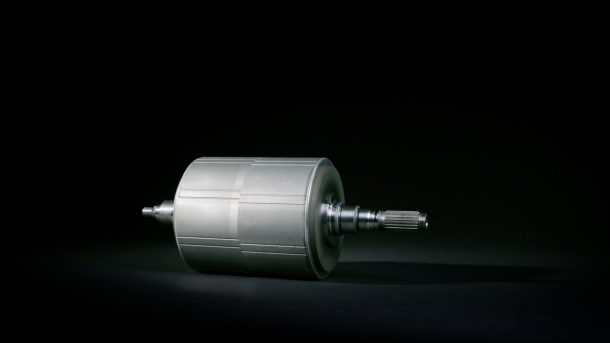
To use limited and valuable resources more effectively, since 2010 Nissan has been working from the design stage to reduce the amount1 of heavy rare-earth elements (REEs) in motor magnets. In addition, Nissan is recycling REEs by removing magnets from motors that do not meet production standards and returning them to suppliers. Currently, multiple steps are involved, including manual disassembly and removal. Therefore, developing a simpler and more economical process is important to achieve increased recycling in the future.
Since 2017, Nissan has been collaborating with Waseda University, which has a strong track record of researching non-ferrous metal recycling and smelting. In March 2020 the collaboration successfully developed a pyrometallurgy process that does not require motor disassembly.

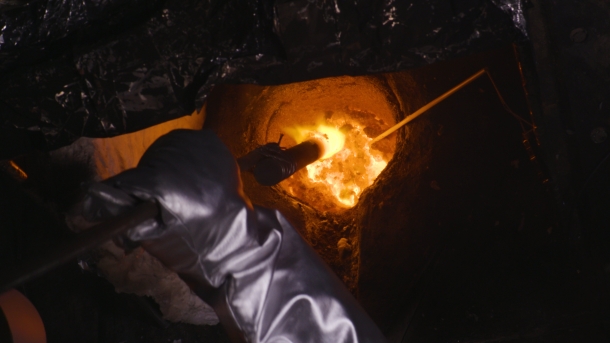
Process overview:
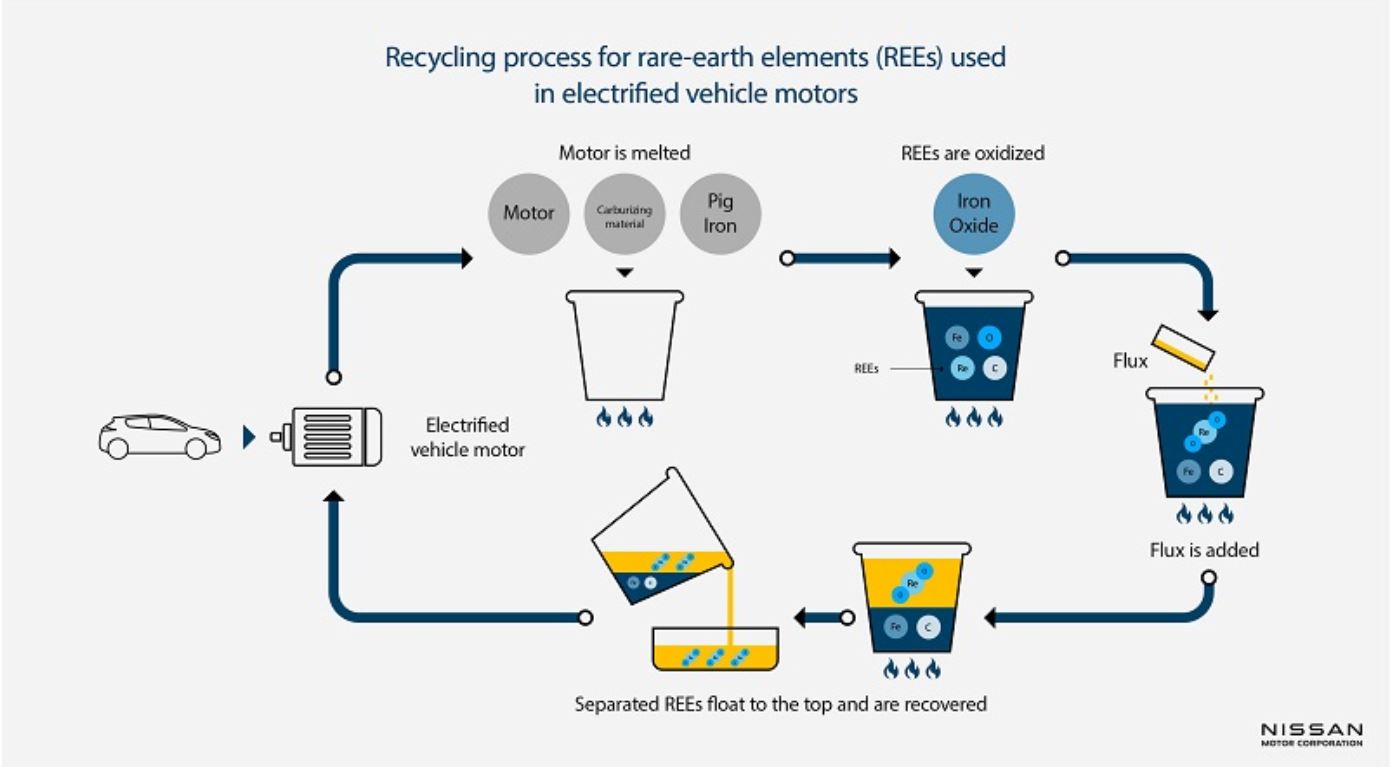
provided by Nissan Motor Corporation

Testing has shown that this process can recover 98% of the motors’ REEs. This method also reduces the recovery process and work time by approximately 50% compared to the current method because there is no need to demagnetize the magnets, nor remove and disassemble them.
Going forward, Waseda and Nissan will continue their large-scale facility testing with the aim of developing practical application, and Nissan will collect motors from electrified vehicles that are being recycled and continue to develop its recycling system.
Nissan will continue to contribute to the building of a cleaner, safer and more inclusive society as part of its efforts to develop a sustainable society. Through its Nissan Green Program 2022, Nissan is addressing four priority issues: climate change, resource dependency, air quality and water scarcity. Nissan will continue to aim for carbon neutrality and zero new material resource use, and will simultaneously promote the use of electrified vehicles and the recycling and reduced use of REEs.
1 The Nissan Note e-POWER produced in FY2020 uses magnets with 85% fewer heavy REEs than the Nissan LEAF produced in FY2010.
高井啓明氏 井上宇市記念賞受賞 記念講演会」のお知らせ
この度、高井啓明さん(竹中工務店 苗S55)が、公益社団法人空気調和・衛生工学会より「第11回井上宇市記念賞」を受賞され、その記念講演会を開催いたしますので、下記の通りご案内申し上げます。
なお、本講演会は、早稲田大学建築学科の特別講義として行われます。学生の皆様の参加も大歓迎です。
【講演会概要】
① 日時:2021年9月25日(土) 15:00~17:30(14:30~アクセス開始)
② 会場:WEB開催(Zoom Webinar利用)
③ 講演テーマ:『継続的な委員会活動と連携した環境・設備計画の実践』
④ 参加費:無料
・講演会詳細および参加申し込みは、下記URLをご参照ください。申し込み締め切り:9/10(金)
https://forms.office.com/r/fc6BSgUW5x
・Zoom Webinar の参加URLは、申込みをいただいた方に、改めてご案内いたします。
【問合せ先】 早稲田大学創造理工学部建築学科田辺研究室
株式会社竹中工務店 東京本店設計部
大宮由紀夫 E-mail: [email protected]
鈴木尚昭 E-mail: [email protected]
演題:The New General Service List (NGSL) Project: A Modular Approach for the Language Vocabulary
日時:2021年9月10日(金)15:00-16:00
会場:Zoomによるオンライン講演会
講師:BROWNE,Charles Munson(明治学院大学教授)
対象:学部生、大学院生、教職員、一般の方
参加方法:参加無料、事前申込制
事前申込先:https://forms.office.com/r/fFf5A3HeEc
申込締切:2021年9月9日(木) 17:00
主催:英語教育センター
問合せ:早稲田大学 理工センター 総務課
TEL:03-5286-3000

The National Institute of Information and Communications Technology (NICT, President: TOKUDA Hideyuki, Ph.D.), Sumitomo Osaka Cement Co., Ltd. (President: MOROHASHI Hirotsune), and Waseda University (President: TANAKA Aiji) jointly developed the first transparent fiber–millimeter-wave–fiber system in the 100-GHz band using a low-loss broadband optical modulator with direct photonic down-conversion. The developed broadband modulator and photonic down-conversion technology were utilized to successfully demonstrate a high-speed transmission of more than 70 Gbit/s over a wired and wireless converged system consisting of two optical fiber links and a 20 m radio link at 101 GHz.
The utilization of a low-loss broadband optical modulator for the direct conversion of a millimeter-wave signal to an optical signal*1 significantly simplified the millimeter-wave radio receiver because it included only a radio front end and an optical modulator. In addition, by adopting direct photonic down-conversion technology*2 for simultaneous detection and down-conversion of the signal to the microwave band, the fiber-radio receiver and the subsequent digital signal processing could be considerably simplified, thus rendering the proposed system a promising solution for high-capacity, low-latency, and low-power consumption fiber–wireless transmission in 5G and beyond networks.
The results of this demonstration were published as a post-deadline paper presentation at the 2021 International Conference on Optical Fiber Communications (OFC 2021).
Fiber–wireless systems in high-frequency bands are a promising technology for inter-building connections, disaster recovery, and mobile transport networks, especially in 5G and beyond era. To date, most systems rely on the use of electronics-based receivers for radio-to-optical conversion, which generally feature less bandwidth and complicated antenna sites. Achieving fully transparent radio–optical conversion using photonic solutions is promising for increasing the transmission capacity and simplifying the antenna sites. However, the frequency of radio links in the previous systems that utilized the photonic conversion method was limited to below 90 GHz owing to the limited bandwidth of optical modulators. Recently, a plasmonic modulator was employed to realize a transparent bridge system in high-frequency bands. Generally, plasmonic modulators exhibit high insertion loss, which requires the use of optical amplifiers. However, this increases the optical noise, system cost, and the antenna site complexity.
On the other hand, most of the previous systems utilized coherent detection by using free-running lasers for signal detection at the fiber-radio receiver, which significantly increased the system complexity, frequency offset, and phase noise of the detected signal, thus requiring complicated digital signal processing algorithms for signal recovery. Therefore, employing a direct photonic down-conversion technology to simultaneously detect and down-convert the signal to the microwave band using a coherent two-tone optical signal generation*3 is promising for simplifying the system and reducing the cost and power consumption.
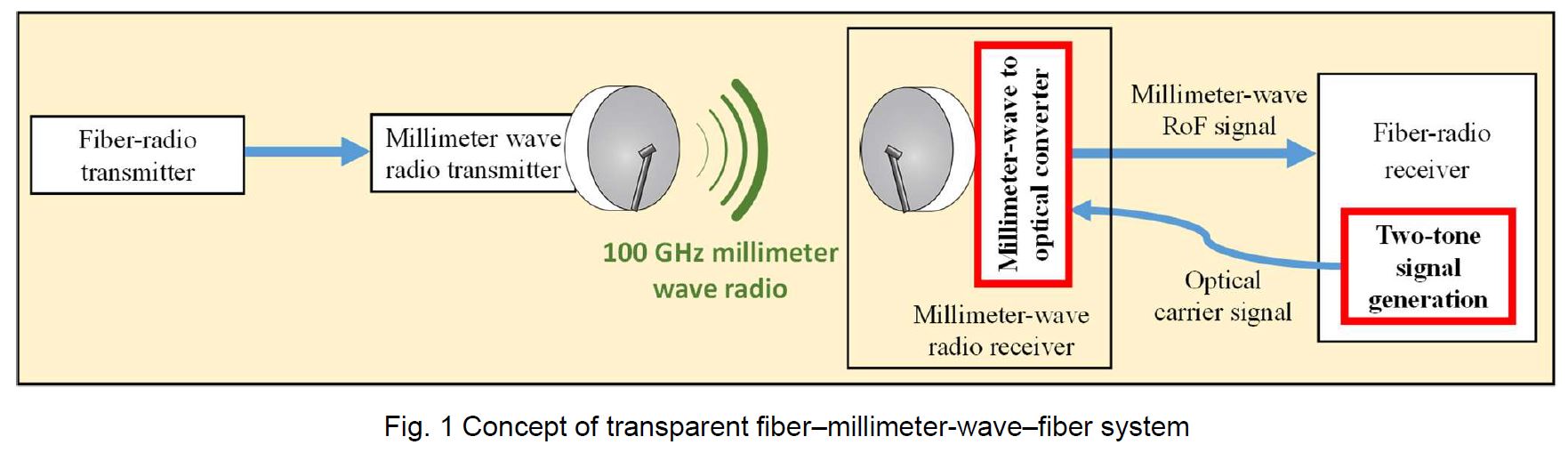
In this work, we demonstrated the first transparent fiber–millimeter-wave–fiber system in the 100-GHz band (see Fig. 1) using two key element technologies: (i) a low-loss broadband optical modulator, and (ii) direct photonic down-conversion. For direct conversion of a millimeter-wave signal to an optical signal, we fabricated and employed a broadband modulator*4 for operation up to 110 GHz. This was achieved by performing Ti diffusion on the x-cut thin-film lithium niobate in the low dielectric constant layer. In addition, we employed a photonic down-conversion method based on a coherent two-tone optical signal generation technology to simultaneously detect and down-convert the signal to the microwave band. This significantly simplified the system and reduced the frequency offset and phase noise, as compared to systems utilizing coherent detection. Using the technologies developed in this study, we successfully transmitted 64-quadrature amplitude modulation (QAM) orthogonal frequency division multiplexing (OFDM) signal*5 with a line rate of 71.4 Gbit/s over a system consisting of two fiber links and a 20 m radio link at 101 GHz.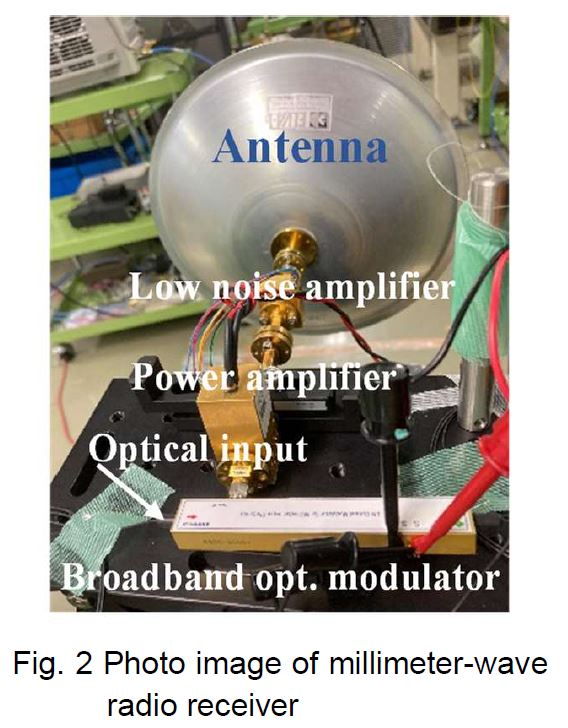
The system consists of the following key element technologies:
The optical carrier for data modulation at the antenna site was remotely generated and distributed from the fiber-radio receiver, which significantly simplified the antenna site and eased its operation and management. In addition, owing to the use of direct photonic down-conversion and detection technology at the fiber-radio receiver, the frequency offset and phase noise of the detected signal could be largely suppressed. This considerably reduced the receiver complexity and the subsequent digital signal processing. The proposed system is promising for high-speed, low-latency, and low-power-consumption communication links in 5G and beyond networks.
In the future, we will further study the millimeter-wave-to-optical conversion device and fiber wireless technology that were developed in this study to further increase the radio frequency and transmission capacity. In addition, we will promote international standardization activities and social implementation activities related to fiber wireless communication systems.
The paper containing the results of this demonstration was published at the 2021 International Conference on Optical Fiber Communication (OFC 2021, June 6 (Sun.) to June 11 (Fri.)), one of the largest international conferences in the field of optical fiber communications. It was highly evaluated and was presented in the Post Deadline session, which is known to release the latest important research achievements, on June 11 (Fri) 2021 local time.
International Conference: Optical Fiber Communications (OFC 2021) June 2021,
paper F3C.4 (Post Deadline Paper)
Title: Transparent Fiber–Radio–Fiber Bridge at 101 GHz using Optical Modulator and Direct Photonic Down-Conversion
Authors: Pham Tien Dat, Yuya Yamaguchi, Keizo Inagaki, Masayuki Motoya, Satoshi Oikawa, Junichiro Ichikawa, Atsushi Kanno, Naokatsu Yamamoto, Tetsuya Kawanishi
It is a technology that converts a wireless signal in the millimeter-wave band to an optical signal without down-conversion of frequency. On the contrary, in the electronics-based conversion method, the millimeter-wave signal needs to be down-converted to a lower frequency signal in the microwave band before its conversion into an optical signal. The direct conversion of a millimeter-wave signal to an optical signal can be realized using a broadband optical modulator or plasmonic modulator. This significantly simplifies the antenna site.
It is a technology used for detecting and down-converting a millimeter-wave signal to a microwave band signal using optical signals from the same light source. In this technology, a two-tone optical signal consisting of the two optical sidebands with a frequency separation that is approximately equal to the frequency of the millimeter-wave signal is generated from a single light source. One of the sidebands is modulated by the millimeter-wave signal, and an optical double-sideband carrier-suppressed signal is generated. One of the modulated sidebands is selected using optical filtering. Finally, the modulated and unmodulated sidebands are combined and input to a low-speed photodetector to be converted to an electrical signal in the microwave band.
This technology generates two coherent optical signals from the same light source using optical modulation technology. In particular, an optical signal consisting of odd or even order harmonic sidebands is generated by applying a clock signal to an optical modulator and controlling the bias voltage.
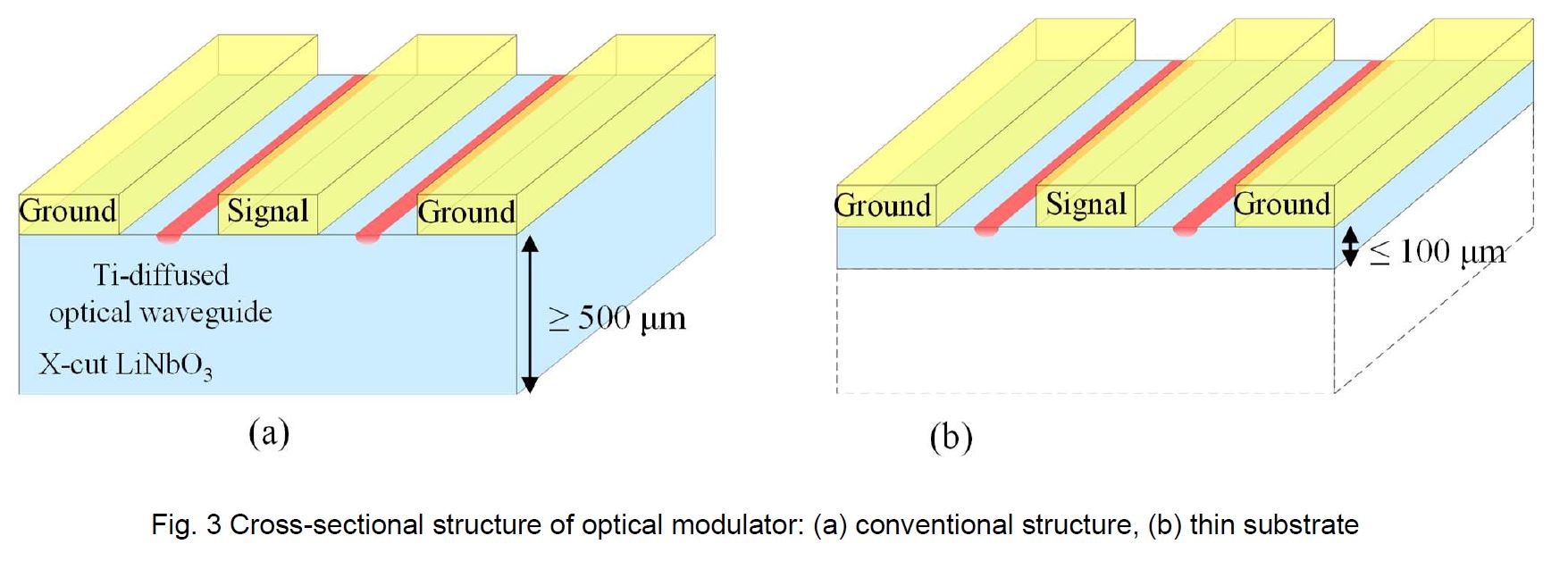
A broadband Mach–Zehnder modulator (MZM) can be fabricated using a thin substrate. In this work, we fabricated a broadband MZM, in which Mach–Zehnder interferometer waveguides were fabricated by Ti diffusion on the x-cut thin-film lithium niobate in the low dielectric constant layer. This was done to achieve ripple-free operation and maximized electro-optic responsivity up to 110 GHz. By thinning the substrate, as shown in Figs. 3(a) and (b), the frequency ripple due to mode coupling between the coplanar guided mode and substrate mode can be suppressed. The electrodes were also optimized to reduce electrical propagation loss to attain high sensitivity. The optical insertion loss, including fiber pigtails, is approximately 4.6 dB at 1550 nm. The half-wave voltage at 100 GHz is approximately 6.7 V, demonstrating a sufficiently low value for high-sensitivity conversion of a millimeter-wave signal to an optical signal at the antenna site.
OFDM is a digital multi-carrier modulation scheme that uses multiple subcarriers within the same single channel. Instead of transmitting a high-rate data stream using a single subcarrier, OFDM uses a large number of closely spaced orthogonal subcarriers that are transmitted in parallel. In this work, subcarriers are modulated with 64 QAM symbols, each of which consists of six input data bits.
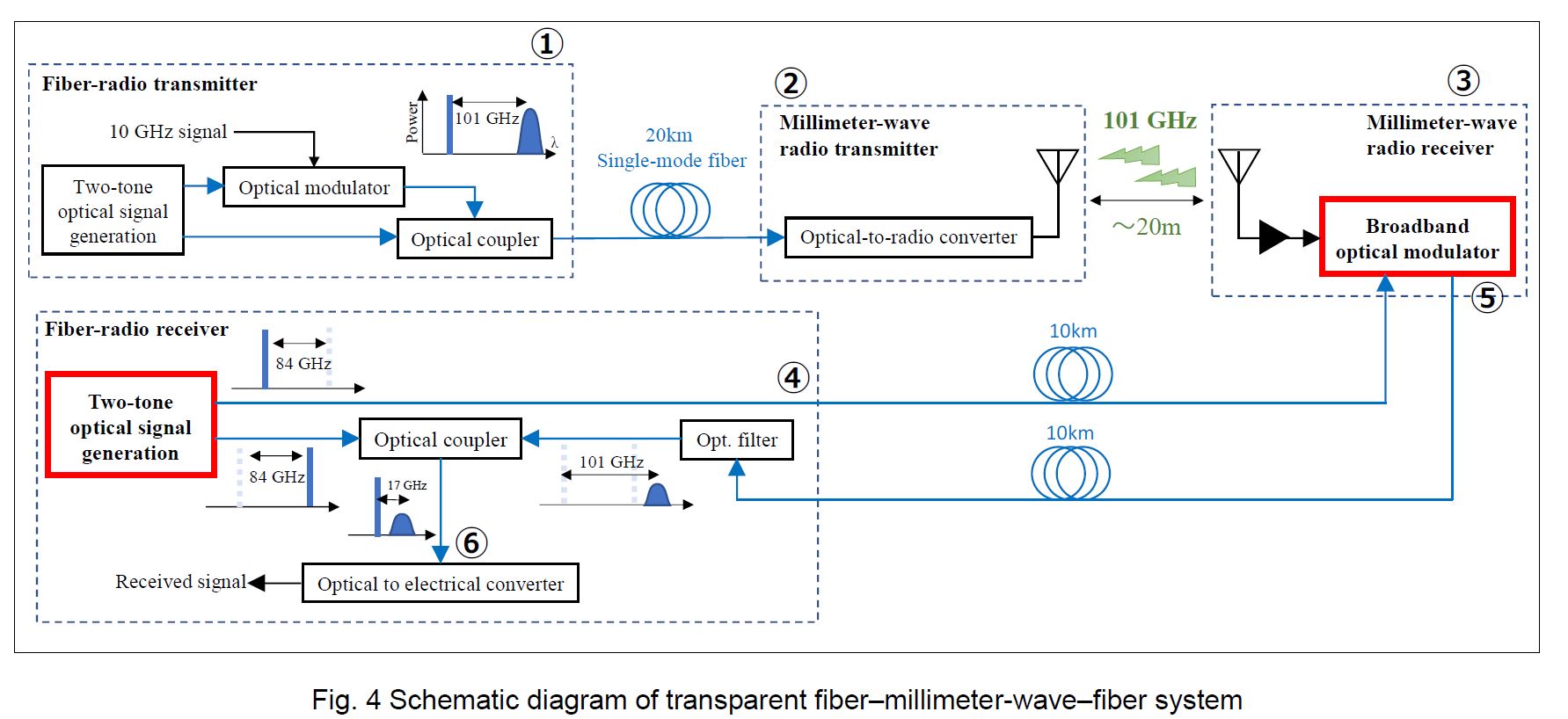
Fig. 4 shows a schematic diagram of the proposed system, which includes six main parts: a fiber-radio transmitter, a millimeter-wave radio transmitter, a millimeter-wave radio receiver, a fiber-radio receiver, millimeter-wave-to-optical conversion, and signal down-conversion and detection.
(1) Fiber-radio transmitter
This block generates and modulates signals. A two-tone optical signal with a frequency separation of 91 GHz was generated using optical modulation technology. The two optical sidebands were separated, and one of them was modulated by a 10 GHz radio signal. The bias voltage to the modulator was controlled to generate only the upper modulation sideband. The modulated and unmodulated sidebands were combined to form a 101-GHz radio-over-fiber (RoF) signal.
(2) Millimeter-wave radio transmitter
After transmitting over a 20-km single-mode fiber, the RoF signal was up-converted to a 101-GHz millimeter-wave radio signal using a high-speed photodetector. The generated radio signal was emitted into free space using a millimeter-wave antenna.
(3) Millimeter-wave radio receiver
The millimeter-wave signal was received by another millimeter-wave antenna, amplified, and converted to an optical signal using the developed high-speed optical modulator.
(4) Fiber-radio receiver
Another two-tone optical signal with a frequency separation of 84 GHz between the two sidebands was generated. One of the sidebands was transmitted to a millimeter-wave radio receiver for data modulation.
(5) Millimeter-wave-to-optical conversion
The optical carrier signal generated at (4) was modulated by the 101 GHz millimeter-wave signal obtained from (3), and the bias voltage to the modulator was controlled to generate a double-sideband suppressed carrier signal. The modulated signal was transmitted to the fiber-radio receiver using a 10-km single-mode fiber link.
(6) Signal down-conversion and detection
One of the modulated sidebands from (5) was selected using optical filtering and combined with the unmodulated sideband of the generated two-tone optical signal from (4) to form an RoF signal with a center frequency of 17 GHz (= 101–84GHz). The signal was converted to a microwave band signal using a low-speed photodetector.
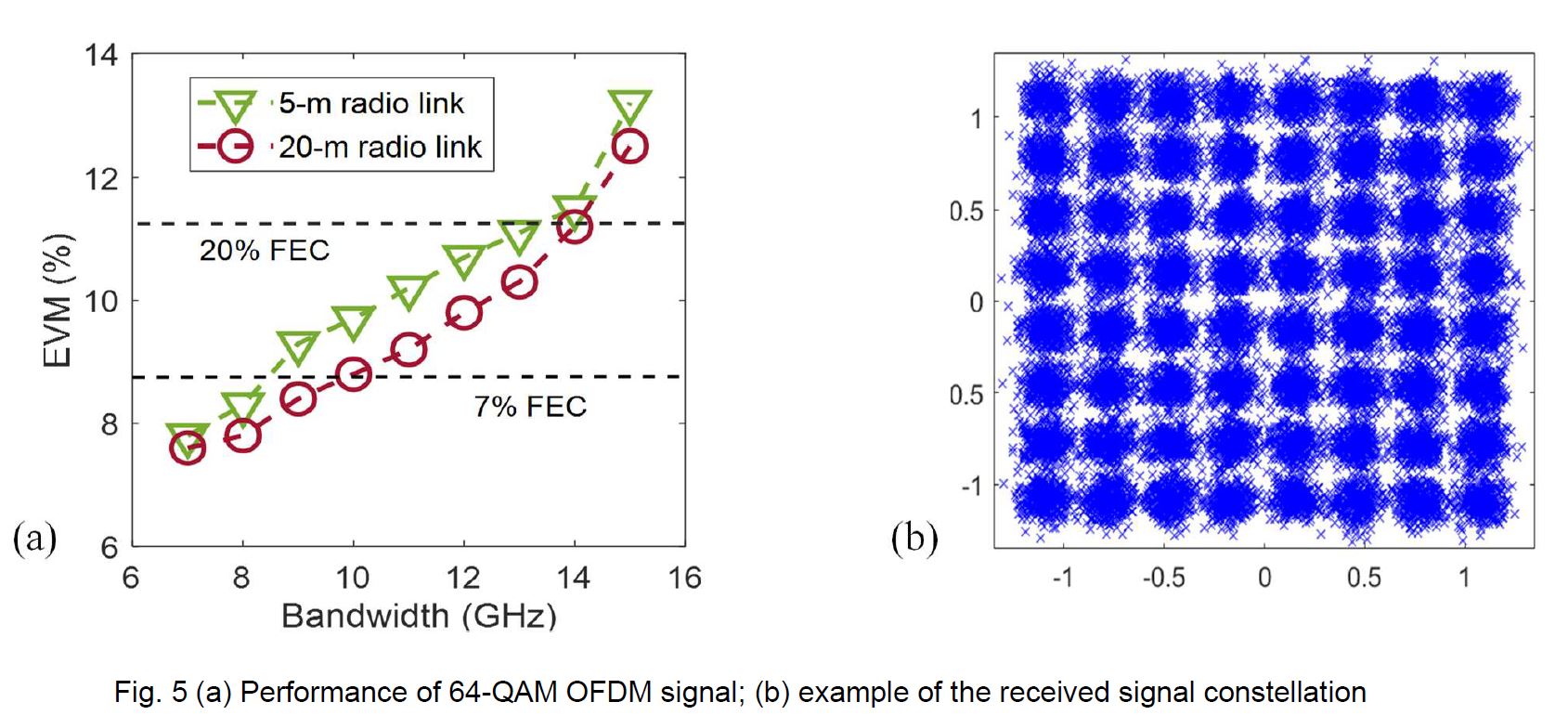
In the demonstration, an OFDM signal at 10 GHz was generated and transmitted over the system. The performance measured in terms of the error vector magnitude (EVM) for the 64-QAM OFDM signal is plotted in Fig. 5(a) for different signal bandwidths. Considering a forward error correction overhead of 20 %, which requires an EVM value of 11.2 %, a satisfactory transmission performance was experimentally confirmed for the OFDM signal with a bandwidth of 14 GHz or smaller. This confirmed that a line rate of 71.4 Gbit/s could be attained when transmitting a 14-GHz bandwidth signal that consisted of 4096 subcarriers, of which, 15 % were inactive at the band edges. The superior performance of the system using a 20 m radio link could be attributed to the better power adjustment of the fiber-radio transmitter. An example of the received signal constellation is shown in Fig. 5 (b).
演題:Machine Learning for Language Learning
日時:2021年8月24日(火)9:00-10:00
会場:Zoomによるオンライン講演会
講師:萩原 正人(Octanove Labs経営者・技術者・研究者)
対象:学部生、大学院生、教職員、一般の方
参加方法:参加無料、事前申込制
事前申込先:https://forms.office.com/r/VWB0gaKNpu
申込締切:2021年8月23日(月) 17:00
主催:英語教育センター
問合せ:早稲田大学 理工センター 総務課
TEL:03-5286-3000
