リーディングビュー

【Video】Faculty of Science and Engineering

Introduction​

Faculty of Science and Engineering, WASEDA UNIVERSITY (Video) Nishi-Waseda Campus (4K Drone View)
VR Campus Tour – Nishi-Waseda Campus

Research

1 minute video – Material Characterization Central Laboratory 1 minute video – Waseda’s Robot Research
under construction under construction
1 minute video – TWIns 1 minute video – Wave Basin
under construction under construction

Education

1 minute video – Science and Engineering Library 1 minute video – Laboratories for Basic Experiments (Chemistry)
under construction under construction
1 minute video – Laboratories for Basic Engineering Experiments 1 minute video – Laboratories for Fruid and Control Engineering
under construction under construction
1 minute video – Manufacturing Laboratory 1 minute video – Materials Engineerign Laboratory
under construction under construction
1 minute video – Architecture Design Studio
under construction

Campus Life

1 minute video – Faculty of Science and Engineering Cafeteria 1 minute video – Rohm Square Cafeteria
under construction under construction
1 minute video – Coffee Shop 1 minute video – Learning Space
under construction under construction
1 minute video – Waseda Monodukuri Workshop (Waseda FabLab)
under construction

Nishiwaseda Campus

1 minute video – Nishiwaseda Campus 1 minute video – Court Yard
under construction under construction
1 minute video – Okuma Statue 1 minute video – Shuttle Bus
under construction under construction

Topics

Entrance Ceremony (2019 April)  Graduation Ceremony (2019 March) 
under construction under construction
Entrance Ceremony (2018 September)  Open Campus 2018 – Student Life Introduction
under construction under construction
Message from Student For a Brighter Tomorrow
under construction under construction
  •  

【Video】School of Advanced Science and Engineering

Mock Lecture

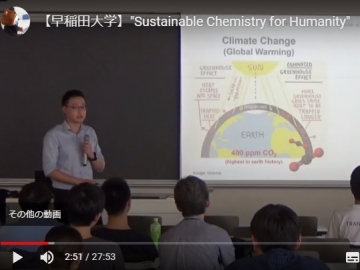
Major in Physics “Introduction to Cosmic Rays and the CALET Space Mission Major in Chemistry “Sustainable Chemistry for Humanity”

Research​​

Waseda Researcher – Yasuhiro Hayashi Waseda Researcher – Yasushi Sekine
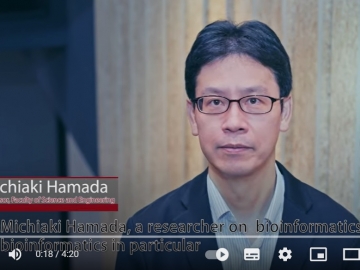
Waseda Researcher – Suguru Noda Waseda Researcher – Michiaki Hamada
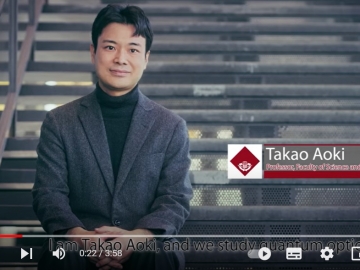
Waseda Researcher – Takao Aoki
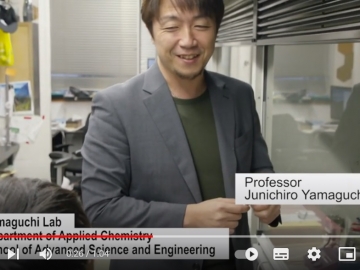
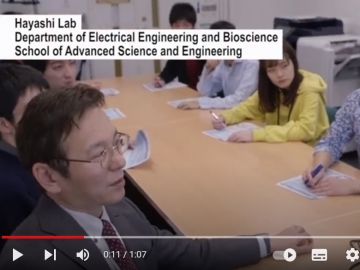
Yamaguchi Lab – Department of Applied Chemistry Hayashi Lab – Department of Electrical Engineering and Bioscience


  •  

【Video】School of Creative Science and Engineering

Mock Lecture

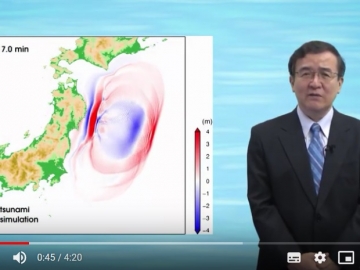
Department of Civil and Environmental Engineering “Tsunamis and Storm Surges: Introduction to Coastal Disasters” Major in Civil and Environmental Engineering “Disaster prevention & mitigation for sustainable society”

Research

Waseda Researcher – Chiharu Tokoro Waseda Researcher – Hiroyasu Iwata
Shibayama Lab – Department of Civil and Environmental Engineering Takizawa Lab – Department of Modern Mechanical Engineering


  •  

【Video】School of Fundamental Science and Engineering

Mock Lecture

Major in Mathematics “Mathematics in Action” Major in Computer Science and Communications Engineering “A mini- introduction to information theory: What is the weight of information?”

Research

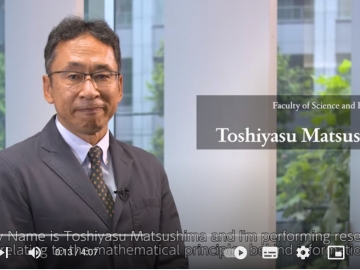
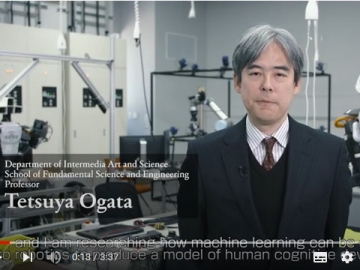
Waseda Researcher – Toshiyasu Matsushima and Manabu Kobayashi, Center for Data Science Waseda Researcher – Tetsuya Ogata
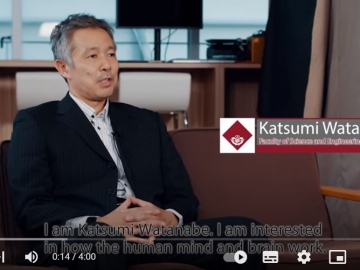
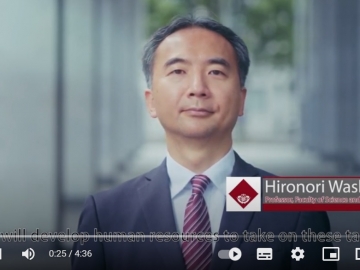
Waseda Researcher – Katsumi Watanabe Waseda Researcher – Hironori Washizaki
Shimizu Lab – Department of Computer Science and Engineering Hashida Lab – Department of Intermedia Art and Science


  •  

Visualizing Complex Electron Wavefunction Using High-Resolution Attosecond Technology

Researchers successfully record the phase distribution of electrons, unveiling the detailed structure of its complex wavefunction

The structure, dynamics, and functions of materials are predominantly determined by their constituent electrons. Owing to their quantum nature, electrons have “wave”-like characteristics. However, measuring the phase of an electron and its complex electron wavefunction is challenging. Using state-of-the-art attosecond technology, researchers at Waseda University and National Research Council of Canada have now successfully recorded the phase distribution of electrons ejected from a neon atom, allowing a complete, detailed visualization of the complex electron wavefunction.

The early 20th century saw the advent of quantum mechanics to describe the properties of small particles, such as electrons or atoms. Schrödinger’s equation in quantum mechanics can successfully predict the electronic structure of atoms or molecules. However, the “duality” of matter, referring to the dual “particle” and “wave” nature of electrons, remained a controversial issue. Physicists use a complex wavefunction to represent the wave nature of an electron. “Complex” numbers are those that have both “real” and “imaginary” parts—the ratio of which is referred to as the “phase”. However, all directly measurable quantities must be “real”. This leads to the following challenge: when the electron hits a detector, the “complex” phase information of the wavefunction disappears, leaving only the square of the amplitude of the wavefunction (a “real” value) to be recorded. This means that electrons are detected only as particles, which makes it difficult to explain their dual properties in atoms.

The ensuing century witnessed a new, evolving era of physics, namely, attosecond physics. The attosecond is a very short time scale, a billionth of a billionth of a second. “Attosecond physics opens a way to measure the phase of electrons. Achieving attosecond time-resolution, electron dynamics can be observed while freezing molecular motion,” explains Professor Hiromichi Niikura from the Department of Applied Physics, Waseda University, Japan, who, along with Professor D. M. Villeneuve—a principal research scientist at the Joint Attosecond Science Laboratory, National Research Council, and adjunct professor at University of Ottawa—pioneered the field of attosecond physics. Niikura and Villeneuve had previously developed a breakthrough method, attosecond re-collision, and also demonstrated the imaging of a molecular orbital or electron wavefunction in a molecule.

In a recent study published in Volume 106 Issue 6 (2022; page 063513) of Physical Review A on 23 December, 2022, these researchers employed another approach involving attosecond physics, using an attosecond laser pulse, or high-harmonic generation, to visualize a complex wavefunction. The attosecond laser pulse consists of coherent light with a wavelength much shorter than ultra-violet, referred to as extreme ultra-violet (EUV) light. When this pulse irradiates a gas, an electron is ejected. This process is referred to as photoionization. The attosecond pulse consists of a set of “harmonics” or different colors of light. By controlling the generation of the attosecond pulse, the researchers isolated two photoionization pathways—one consisting of a particular harmonic, and the other consisting of another harmonic along with an infrared pulse—to ionize neon. The electron wavefunctions produced by both pathways can interfere with each other. The interference pattern varies with the attosecond delay between the harmonics and the IR pulses. The team determined the phase and amplitude distributions of the photoelectron from the interference pattern and visualized its complex wavefunction. As the energy resolution is smaller than the bandwidth of the attosecond pulses, the researchers were successful in visualizing the detailed wavefunction structure. Furthermore, the researchers developed a method of disentangling the measured wavefunction into wavefunctions that are produced by individual ionization pathways.

Now that the researchers have successfully visualized the complex wavefunction of an electron—something that cannot be seen through conventional photoelectron spectroscopy—there’s so much more they can achieve! Niikura says, “Nowadays, photoelectron spectroscopy using EUV and X-ray has become a basic tool for investigating structures and dynamics of materials. The present method will provide a way to elucidate the quantum properties of electrons.” Visualizing the complete, detailed, complex electron wavefunction will be of significant impact in the fields of nanotechnology, chemistry, and molecular biology.

Reference

Authors: Takashi Nakajima1, Tasuku Shinoda1, D. M. Villeneuve2 and Hiromichi Niikura1
Title of original paper: High-resolution attosecond imaging of an atomic electron wavefunction in momentum space
Journal: Physical Review A
DOI: 10.1103/PhysRevA.106.063513
Latest Article Publication Date: 23 December, 2022
Affiliations: 1Department of Applied Physics, Waseda University, Japan
2Joint Attosecond Science Laboratory, National Research Council and University of Ottawa, Ontario, Canada

Image
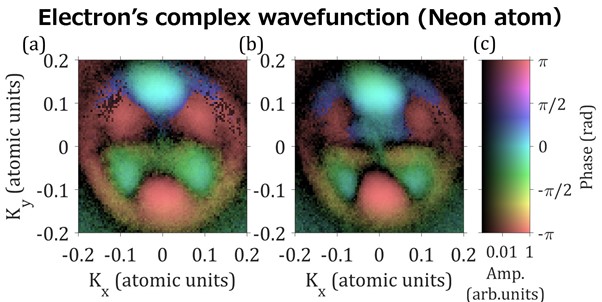
Image title: Visualizing complex photoelectron wavefunctions using attosecond imaging technology
Image caption: Researchers measure the phase and amplitude of the complex electron wavefunctions (a,b), represented by color (or hue) for phase and brightness (or value) for amplitude (plotted in logarithmic scale), in the hue-saturation-value (HSV) color map, as shown in (c).
Image credits: Hiromichi Niikura from Waseda University
License type: Original content

About Professor Hiromichi Niikura from Waseda University

Hiromichi Niikura is a Professor at the Department of Applied Physics, Waseda University. He obtained his bachelors from Kyoto Institute of Technology, masters from Graduate School of Kyoto Institute of Technology, and Ph.D. from Graduate University for Advanced Studies, Institute for Molecular Science, Japan. His research focuses on atomic, molecular, and optical (AMO) physics. He has worked at National Research Council of Canada (2000-2009), where he conducted a pioneering work in attosecond physics, a new emerging field. Niikura was awarded the prestigious Japan Society for Promotion of Science (JSPS) award in 2012. Professor Niikura can be contacted at [email protected].

  •  

「Recent advances on the mathematical analysis of Einstein’s field equations of general relativity」(2023/1/28)

演題:Recent advances on the mathematical analysis of Einstein’s field equations of general relativity


日時:2023年1月28日(土)15時00分~17時00分


会場:西早稲田キャンパス 55号館 N棟 2階 第1会議室 物理学科・応用物理学科会議室


講師:Philippe G. LeFloch(Research ProfessorLaboratoire J-L Lions and CNRS Sorbonne Université, Paris)


対象:学部生・大学院生、教職員、学外者、一般の方


参加方法:入場無料、直接会場へお越しください。


主催:先進理工学研究科 物理学及応用物理学専攻


問合せ:早稲田大学 理工センター 総務課


TEL:03-5286-3000

  •  

「Theoretical studies of optical materials doped with transition metals」(2023/1/26)

演題:Theoretical studies of optical materials doped with transition metals


日時:2023年1月26日(木) 10時30分~12時00分


会場:西早稲田キャンパス 55号館第1会議室


講師:Mikhail Brik(Institute of Physics University of Tartu Professor)


対象:学部生・大学院生、教職員、学外者、一般の方


参加方法:入場無料、直接会場へお越しください。


主催:基幹理工学研究科 電子物理システム学専攻


問合せ:早稲田大学 理工センター 総務課


TEL:03-5286-3000

  •  

「ゲノム分子情報にもとづく生命医科学分野におけるデータサイエンス」(2023/1/26)

演題:ゲノム分子情報にもとづく生命医科学分野におけるデータサイエンス


日時:2023年1月26日(木) 17:00 – 18:30


会場:早稲田大学120-5号館 121会議室

※ハイブリットで開催いたします。遠隔参加希望の場合は以下参照


講師:土方 敦司(東京薬科大学 生命科学部 准教授)


対象:学部生・大学院生、教職員、学外者、一般の方


事前申込先:[email protected]

「お名前」「所属」「メールアドレス」「講演会参加の目的」を明記下さい。

早稲田大学の学生の場合は、学籍番号もご記入ください。

申し込みいただいた方に、zoomアドレスをお送りします。


主催:早稲田大学 先進理工学部 生命医科学科


問合せ:早稲田大学 理工センター 総務課


TEL:03-5286-3000

  •  

「ラジカル種を用いた新奇固体反応の開発: 環状アルコールの開環型フッ素化反応・芳香族臭化物とアルキルピリジニウム塩 との還元的カップリング反応」(2023/2/11)

演題:ラジカル種を用いた新奇固体反応の開発:

環状アルコールの開環型フッ素化反応・芳香族臭化物とアルキルピリジニウム塩

との還元的カップリング反応


日時:2023年2月11日(土)16:30-18:00


会場:早稲田大学 121号館 共通会議室


講師:一色 遼大(北海道大学 化学反応創成研究拠点(WPI-ICReDD)特任助教)


対象:学部生・大学院生、教職員、学外者、一般の方


参加方法:入場無料、直接会場へお越しください。


主催:先進理工学研究科 応用化学専攻


問合せ:早稲田大学 理工センター 総務課


TEL:03-5286-3000

  •  

「新薬 vs. ジェネリック」(2023/1/25)

演題:新薬 vs. ジェネリック


日時:2023年1月25日(水)16:30-18:00


会場:早稲田大学 121号館 コマツ記念ホール


講師:内川 治(東和薬品株式会社上席執行役員 大地化成株式会社代表取締役会長)


対象:学部生・大学院生、教職員、学外者、一般の方


参加方法:入場無料、直接会場へお越しください。


主催:先進理工学研究科 応用化学専攻


問合せ:早稲田大学 理工センター 総務課


TEL:03-5286-3000

  •  

「Frei Otto, Thinking by Modeling」(2023/1/19)

演題:Frei Otto, Thinking by Modeling


日時:2023年1月19日(木) 16時30分~18時00分


会場:オンライン(Zoom)による開催


講師:Georg Vrachliotis (デルフト工科大学, 教授

Full Professor,ChairTheory of Architecture & Digital Culture, Department of ArchitectureTU Delft)


対象:学部生・大学院生、教職員、学外者、一般の方


参加方法:時間になりましたら下記URLよりご入室下さい。


https://list-waseda-jp.zoom.us/j/92365124295?pwd=WGVhUEV4NzVDUW90WkxSMVVIbm9Zdz09


主催:創造理工学研究科 建築学専攻


問合せ:早稲田大学 理工センター 総務課


TEL:03-5286-3000

  •  

Discovering Rare Red Spiral Galaxy Population from Early Universe with the James Webb Space Telescope

Discovering Rare Red Spiral Galaxy Population from Early Universe with the James Webb Space Telescope

The first image of NASA’s James Webb Space Telescope reveals a detailed morphology of highly redshifted spiral galaxies

Morphology of galaxies contain important information about the process of galaxy formation and evolution. With its state-of-the-art resolution, NASA’s James Webb Space Telescope has now captured several red spiral galaxies in its first image at an unprecedented resolution. Researchers from Waseda University have now analyzed these galaxies, revealing that these are among the furthest known spiral galaxies till date. The analysis further detected a passive red spiral galaxy in the early universe, a surprising discovery.

Spiral galaxies represent one of the most spectacular features in our universe. Among them, spiral galaxies in the distant universe contain significant information about their origin and evolution. However, we have had a limited understanding of these galaxies due to them being too distant to study in detail. “While these galaxies were already detected among the previous observations using NASA’s Hubble Space Telescope and Spitzer Space Telescope, their limited spatial resolution and/or sensitivity did not allow us to study their detailed shapes and properties,” explains Junior Researcher Yoshinobu Fudamoto from Waseda University in Japan, who has been researching galaxies’ evolution.

Now, NASA’s James Webb Space Telescope (JWST) has taken things to the next level. In its very first imaging of the galaxy cluster, SMACS J0723.3-7327, JWST has managed to capture infrared images of a population of red spiral galaxies at an unprecedented resolution, revealing their morphology in detail!

Against this backdrop, in a recent article published in The Astrophysical Journal Letters on 21 October 2022, a team of researchers comprising Junior Researcher Yoshinobu Fudamoto, Prof. Akio K. Inoue, and Dr. Yuma Sugahara from Waseda University, Japan, has revealed surprising insights into these red spiral galaxies. Among the several red spiral galaxies detected, the researchers focused on the two most extremely red galaxies, RS13 and RS14. Using spectral energy distribution (SED) analysis, the researchers measured the distribution of energy over wide wavelength range for these galaxies. The SED analysis revealed that these red spiral galaxies belong to the early universe from a period known as the “cosmic noon” (8-10 billion years ago), which followed the Big Bang and the “cosmic dawn.” Remarkably, these are among the farthest known spiral galaxies till date.

Rare, red spiral galaxies account for only 2% of the galaxies in the local universe. This discovery of red spiral galaxies in the early universe, from the JWST observation covering only an insignificant fraction of space, suggests that such spiral galaxies existed in large numbers in the early universe.

As a remarkable improvement over previous IRAC image (above), JWST’s unprecedented spatial resolution and high IR sensitivity reveals the morphological details of the red spiral galaxies (below) RS13 and RS14. This facilitates a detailed analysis revealing hitherto unknown features of red spiral galaxies belonging to the early universe.

The researchers further discovered that one of the red spiral galaxies, RS14, is a “passive” (not forming stars) spiral galaxy, contrary to the intuitive expectation that galaxies in the early universe would be actively forming stars. This detection of a passive spiral galaxy in the JWST’s limited field of view is particularly surprising, since it suggests that such passive spiral galaxies could also exist in large numbers in the early universe.

Overall, the findings of this study significantly enhances our knowledge about red spiral galaxies, and the universe as a whole. “Our study showed for the first time that passive spiral galaxies could be abundant in the early universe. While this paper is a pilot study about spiral galaxies in the early universe, confirming and expanding upon this study would largely influence our understanding of the formation and evolution of galactic morphologies,” concludes Fudamoto.

Reference

Title of original paper: Red Spiral Galaxies at Cosmic Noon Unveiled in the First JWST Image
DOI: 10.3847/2041-8213/ac982b
Journal: The Astrophysical Journal Letters
Article Publication Date: October 21, 2022
Authors: Yoshinobu Fudamoto1,2, Akio K. Inoue1,3, and Yuma Sugahara1,2
Affiliations:
1Waseda Research Institute for Science and Engineering, Faculty of Science and Engineering, Waseda University
2National Astronomical Observatory of Japan
3Department of Physics, School of Advanced Science and Engineering, Faculty of Science and Engineering, Waseda University

  •  

「General Multivariate Hawkes Processes and Induced Population Processes: exact results and large deviations」(2023/1/17)

演題:General Multivariate Hawkes Processes and Induced Population Processes:

exact results and large deviations


日時:2023年1月17日(火)15:00-18:00 ※登壇予定時間 15:00-16:30


会場:西早稲田キャンパス 63号館1階 数学応数会議室


講師:Michael Robertus Hendrikus Mandjes

(Full professor of Probability, Korteweg-de Vries Institute for Mathematics, University of Amsterdam.)


対象:学部生・大学院生、教職員、学外者、一般の方


参加方法:入場無料、直接会場へお越しください。


主催:基幹理工学部 応用数理学科


問合せ:早稲田大学 理工センター 総務課


TEL:03-5286-3000

  •  

「いくつかの楽しい分子との出会い」(2023/1/27)

演題:いくつかの楽しい分子との出会い


日時:2023年1月27日(金)16:30-18:00


会場:西早稲田キャンパス 52号館 2階 202教室


講師:友岡 克彦(九州大学先導物質化学研究所・教授)


対象:学部生・大学院生、教職員、学外者、一般の方


参加方法:入場無料、直接会場へお越しください。


主催:先進理工学研究科 化学・生命化学専攻


問合せ:早稲田大学 理工センター 総務課


TEL:03-5286-3000

  •  

2023年度第1回 社会文化領域コース 進入説明会(1/12オンライン実施・ 要事前登録)のご案内

社会文化領域コース進入説明会(総合機械工学科向け)を、2023年1月12日 (木) にオンラインで開催します。
関心のある学生は、以下のポスターおよび社会文化領域のホームページ上の情報をよく確認し、必要な手続きをとってください。

  •  

「鋳造技術研究会講演「鋳物・ダイカストの冷却時に発生する残留応力や変形の予測と実験的検証  〜冷却中の回復(なまり)挙動をどう考慮するか」(2022/12/21)

演題:鋳造技術研究会講演「鋳物・ダイカストの冷却時に発生する残留応力や変形の予測と実験的検証

〜冷却中の回復(なまり)挙動をどう考慮するか


日時:2022年12月21日(水)13:40-16:40(※ご登壇予定時間:14:20~15:00)


会場:早稲田大学 西早稲田キャンパス 62W号館1階 大会議室A


講師:本山 雄一(国立研究開発法人産業技術総合研究所 主任研究員)


対象:学部生・大学院生、教職員、学外者、一般の方


参加方法:入場無料、直接会場へ


主催:創造理工学研究科 総合機械工学専攻


問合せ:早稲田大学 理工センター 総務課


TEL:03-5286-3000

  •  

「進化分子工学 ~進化によるものづくり・いきものづくり~」(2022/12/21)

演題:進化分子工学 ~進化によるものづくり・いきものづくり~


日時:2022年12月21日(水)16:30-18:00


会場:西早稲田キャンパス 56号館 102室


講師:宮崎 健太郎(大阪大学 生物工学国際交流センター 特任教授)


対象:学部生・大学院生、教職員、学外者、一般の方


参加方法:入場無料、直接会場へお越しください。


主催:先進理工学部 応用化学科


問合せ:早稲田大学 理工センター 総務課


TEL:03-5286-3000

  •  

「環境中での外来遺伝子の取り込みによる細菌の機能進化」(2022/12/9)

演題:環境中での外来遺伝子の取り込みによる細菌の機能進化


日時:2022年12月9日(金) 16:30 – 18:00


会場:早稲田大学120-5号館 121会議室

※ハイブリットで開催いたします。遠隔参加希望の場合は以下参照


講師:野尻 英昭(東京大学アグロバイオテクノロジー研究センター 環境保全工学研究室 教授)


対象:学部生・大学院生、教職員、学外者、一般の方


事前申込先:[email protected]

「お名前」「所属」「メールアドレス」「講演会参加の目的」を明記下さい。

早稲田大学の学生の場合は、学籍番号もご記入ください。

申し込みいただいた方に、zoomアドレスをお送りします。


主催:早稲田大学 先進理工学部 生命医科学科


問合せ:早稲田大学 理工センター 総務課

  •  

「建築と絵画 ――― 芸術は越境する」(2022/12/14)

演題:建築と絵画 ――― 芸術は越境する


日時:2022年12月14日(水) 13時00分~18時00分

13時00分~18時00分の間の180分程度

※途中に15分休憩を2回挟みます。


会場:西早稲田キャンパス 56号館104室


講師:山本 浩二(画家 神戸女学院非常勤講師)


対象:学部生・大学院生、教職員、学外者、一般の方


参加方法:入場無料、直接会場へお越しください。

※13:00開始に遅れないようご参加ください。途中入室はご遠慮ください。


主催:創造理工学部 建築学科


問合せ:早稲田大学 理工センター 総務課


TEL:03-5286-3000

  •  

「「編む建築」〜地域社会を支える建築」(2022/12/6)

演題:「編む建築」〜地域社会を支える建築


日時:2022年12月6日(火)16:30-18:00


会場:西早稲田キャンパス 57号館202室


講師:仲 俊治(仲建築設計スタジオ 代表)


対象:学部生・大学院生、教職員、学外者、一般の方


参加方法:入場無料、直接会場へお越しください。


主催:創造理工学部 建築学科


問合せ:早稲田大学 理工センター 総務課


TEL:03-5286-3000

  •  
❌