 ログイン
ログイン
2024年度 社会文化領域コース 進入説明会(1/11オンライン実施・要事前登録)のご案内
総合機械工学科向けの社会文化領域コース進入説明会を、2024年1月11日 (木) にオンラインで開催します。関心のある学生は、以下のポスターおよび社会文化領域ウェブサイト上の情報をよく確認し、必要な手続きをとってください。

総合機械工学科向けの社会文化領域コース進入説明会を、2024年1月11日 (木) にオンラインで開催します。関心のある学生は、以下のポスターおよび社会文化領域ウェブサイト上の情報をよく確認し、必要な手続きをとってください。
演題:Chemical modification revives nitroxide radicals in catalysis and energy storage
日時:2024年1月22日(月)10:00-11:40
会場:西早稲田キャンパス 55号館S棟610教室
講師:Zhongfan Jia(フリンダース大学准教授)
対象:学部生・大学院生、教職員、学外者、一般の方
参加方法:入場無料、直接会場へお越しください。
主催:先進理工学部 応用化学科
問合せ:早稲田大学 理工センター 総務課
TEL:03-5286-3000
演題:新規運動指標エクササイズゲージの確立と革新的運動模倣薬の創製に向けて
日時:2024年3月1日(金)17:00 – 19:00
会場:早稲田大学 TWIns 生命医科学会議室 02C201
講師:岩部 真人(日本医科大学医学部 教授)
対象:学部生・大学院生、教職員、学外者、一般の方
参加方法:入場無料、直接会場へお越しください。
主催:早稲田大学 先進理工学部 生命医科学科
問合せ:早稲田大学 理工センター 総務課
TEL:03-5286-3000
演題:ピリジン系天然アミノ酸類の構築とバイオマーカー研究
日時:2024年3月1日(金) 16:30-18:10
会場:西早稲田キャンパス 55号館 N棟1階 第二会議室
講師:臼杵 豊展(上智大学 理工学部 物質生命理工学科 教授)
対象:学部生・大学院生、教職員、学外者、一般の方
参加方法:入場無料、直接会場へお越しください。
主催:先進理工学研究科 化学・生命化学専攻
問合せ:早稲田大学 理工センター 総務課
TEL:03-5286-3000
演題:医薬品分子設計のための機械学習技術
日時:2023年12月19日(火)15:05-16:45
会場:西早稲田キャンパス 52号館204室
講師:寺本 礼仁(中外製薬株式会社モダリティ基盤研究部マシンラーニンググループ)
対象:学部生・大学院生、教職員、学外者、一般の方
参加方法:入場無料 直接会場へお越しください。
主催:先進理工学部 電気・情報生命工学科
問合せ:早稲田大学 理工センター 総務課
TEL:03-5286-3000
Glass – whether used to insulate our homes or as the screens in our computers and smartphones – is a fundamental material. Yet, despite its long usage throughout human history, the disordered structure of its atomic configuration still baffles scientists, making understanding and controlling its structural nature challenging. It also makes it difficult to design efficient functional materials made from glass.
To uncover more about the structural regularity hidden in glassy materials, a research group has focused on ring shapes in the chemically bonded networks of glass. The group, which included Professor Motoki Shiga from Tohoku University’s Unprecedented-scale Data Analytics Center, and Professor Akihiko Hirata from Waseda University created new ways in which to quantify the rings’ three-dimensional structure and structural symmetries: “roundness” and “roughness.”
Using these indicators enabled the group to determine the exact number of representative ring shapes in crystalline and glassy silica (SiO2), finding a mixture of rings unique to glass and ones that resembled the rings in the crystals.
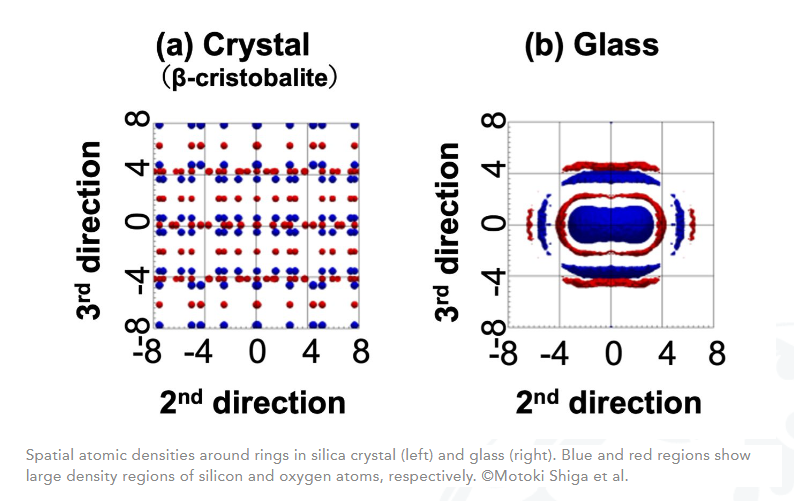
Additionally, the researchers developed a technique to measure the spatial atomic densities around rings by determining the direction of each ring.
They revealed that there is anisotropy around the ring, i.e., that the regulation of the atomic configuration is not uniform in all directions, and that the structural ordering related to the ring-originated anisotropy is consistent with experimental evidence, like the diffraction data of SiO2. It was also revealed that there were specific areas where the atomic arrangement followed some degree of order or regularity, even though it appeared to be a discorded and chaotic arrangement of atoms in glassy silica.
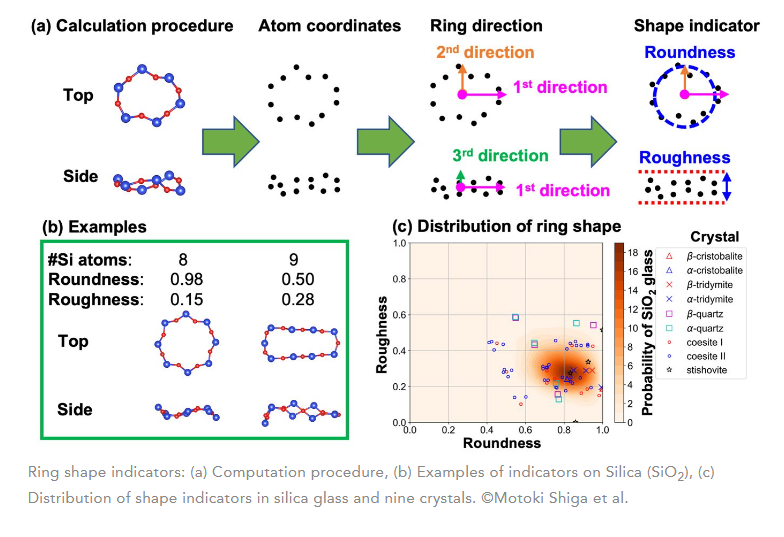
“The structural unit and structural order beyond the chemical bond had long been assumed through experimental observations but its identification has eluded scientists until now,” says Shiga. “Furthermore, our successful analysis contributes to understanding phase-transitions, such as vitrification and crystallization of materials, and provides the mathematical descriptions necessary for controlling material structures and material properties.”
Looking ahead, Shiga and his colleagues will use these techniques to come up with procedures for exploring glass materials, procedures that are based on data-driven approaches like machine learning and AI.
Their findings were published open access in the journal Communication Materials on November 3, 2023.
Title: Ring-originated anisotropy of local structural ordering in amorphous and crystalline silicon dioxide
Authors: Motoki Shiga, Akihiko Hirata, Yohei Onodera, and Hirokazu Masai
Journal: Communications Materials
DOI: 10.1038/s43246-023-00416-w
演題:数学的公平性と差別の関連性試論:LLM特有の事情はあるか?
http://sakailab.com/harukamaeda2023/
日時:2023年12月13日(水)18:00-19:10
会場:西早稲田キャンパス 63号館5階06室
講師:前田春香(京都大学 大学院法学研究科 特定研究員)
対象:学部生・大学院生、教職員、学外者、一般の方
参加方法:入場無料 直接会場へお越しください。
主催:基幹理工学部 情報理工学科
問合せ:早稲田大学 理工センター 総務課
TEL:03-5286-3000
演題:熱力学計算ソフトウェアによる膨大な計算データを用いた対話的合金設計手法の検討
日時:2023年12月13日(水)13:00-17:00(※ご登壇予定時間:13:00-14:00)
会場:早稲田大学 各務記念材料技術研究所 講演室
講師:本山 雄一(早稲田大学 客員准教授・産業技術総合研究所 主任研究員)
対象:学部生・大学院生、教職員、学外者、一般の方
参加方法:入場無料、直接会場へ
主催:創造理工学研究科 総合機械工学専攻
問合せ:早稲田大学 理工センター 総務課
TEL:03-5286-3000
演題:Circular Architecture
日時:2023年11月29日(水)14:00-15:40
会場:西早稲田キャンパス 56号館104教室
講師:藤 貴彰(tyfa/Takaaki Fuji + Yuko Fuji Architecture 代表・三菱地所設計チーフアーキテクト)
対象:学部生・大学院生、教職員、学外者、一般の方
参加方法:入場無料、直接会場へお越しください。
主催:創造理工学部 建築学科
問合せ:早稲田大学 理工センター 総務課
TEL:03-5286-3000
Researchers present a novel experimental system for simultaneous measurement of dynamic mechanical properties and X-ray computed tomography
Rubber-like materials can exhibit both spring-like and flow-like behaviors simultaneously, which contributes to their exceptional damping abilities. To understand the dynamic viscoelasticity of these materials, researchers from Japan have recently developed a novel system that can conduct dynamic mechanical analysis and dynamic micro X-ray computed tomography simultaneously. This technology can enhance our understanding of the microstructure of viscoelastic materials and pave the way for the development of better materials.
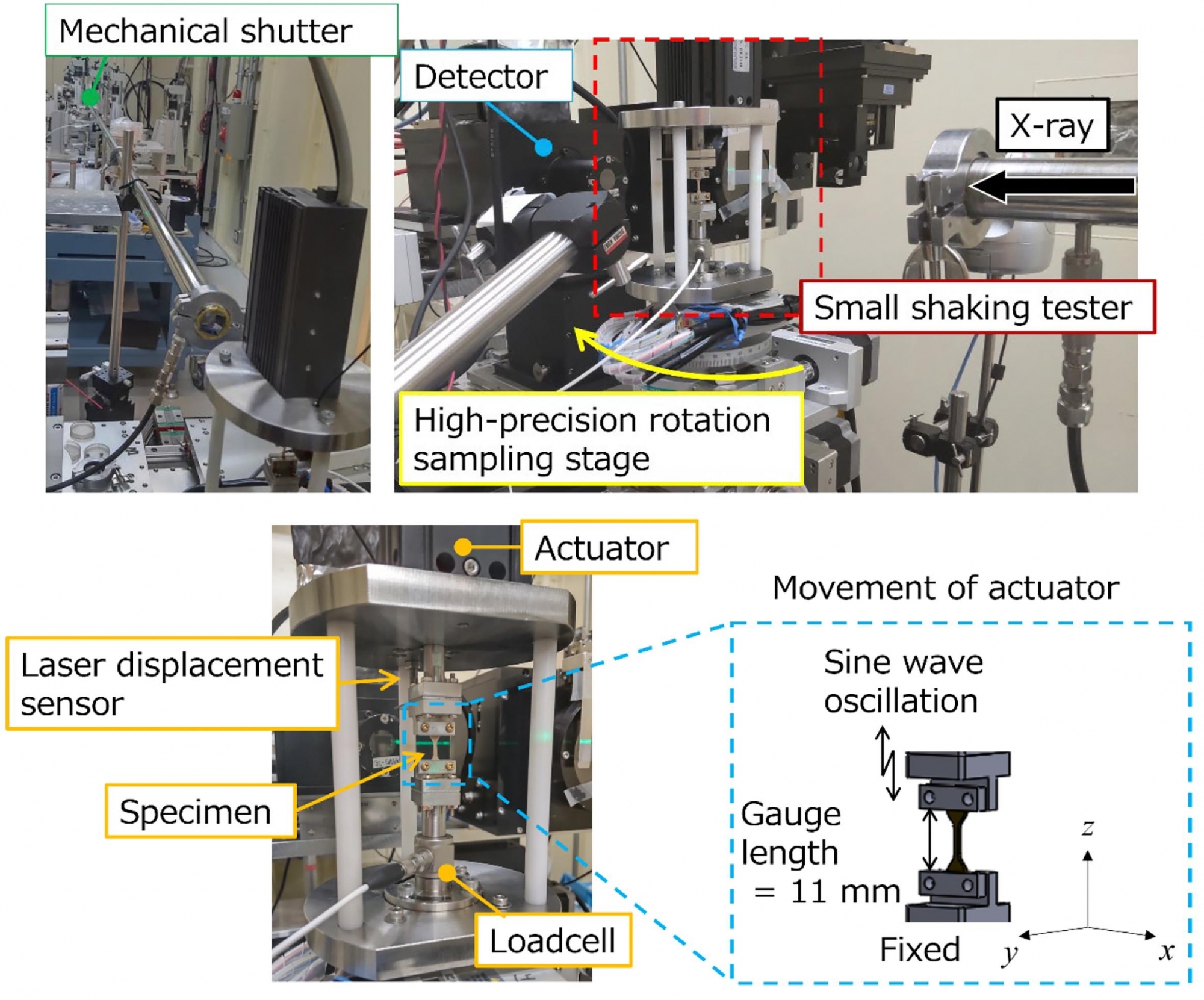
Experimental setup for the simultaneous measurement of dynamic mechanical properties and dynamic micro X-ray CT.
Rubber-like materials, commonly used in dampeners, possess a unique property known as dynamic viscoelasticity, enabling them to convert mechanical energy from vibrations into heat while exhibiting spring-like and flow-like behaviors simultaneously. Customization of these materials is possible by blending them with compounds of specific molecular structures, depending on the dynamic viscosity requirements.
However, the underlying mechanisms behind the distinct mechanical properties of these materials remain unclear. A primary reason for this knowledge gap has been the absence of a comprehensive system capable of simultaneously measuring the mechanical properties and observing the microstructural dynamics of these materials. While X-ray computed tomography (CT) has recently emerged as a promising option for a non-destructive inspection of the internal structure of materials down to nano-scale resolutions, it is not suited for observation under dynamic conditions.
Against this backdrop, a team of researchers, led by Associate Professor (tenure-track) Masami Matsubara from the School of Creative Science and Engineering at the Faculty of Engineering at Waseda University in Japan, has now developed an innovative system that can conduct dynamic mechanical analysis and dynamic micro X-ray CT imaging simultaneously. Their study was made available online on October 19, 2023 and will be published in Volume 205 of the journal Mechanical Systems and Signal Processing on December 15, 2023.
“By integrating X-ray CT imaging performed at the large synchrotron radiation facility Spring-8(BL20XU) and mechanical analysis under dynamic conditions, we can elucidate the relationship between a material’s internal structure, its dynamic behavior, and its damping properties,” explains Dr. Matsubara. At the core of this novel system is the dynamic micro X-ray CT and a specially designed compact shaker developed by the team that is capable of precise adjustment of vibration amplitude and frequency.
The team utilized this innovative system to investigate the distinctions between styrene-butadiene rubber (SBR) and natural rubber (NR), as well as to explore how the shape and size of ZnO particles influence the dynamic behavior of SBR composites.
The researchers conducted dynamic micro X-ray CT scans on these materials, rotating them during imaging while simultaneously subjecting them to vibrations from the shaker. They then developed histograms of local strain amplitudes by utilizing the local strains extracted from the 3D reconstructed images of the materials’ internal structures. These histograms, in conjunction with the materials’ loss factor, a measure of the inherent damping of a material, were analyzed to understand their dynamic behavior.
When comparing materials SBR and NR, which have significantly different loss factors, the team found no discernible differences between their local strain amplitude histograms. However, the histograms displayed wider strain distributions in the presence of composite particles like ZnO. This suggests that strain within these materials is non-uniform and depends on the shape and size of the particles, which may have masked any changes from the addition of the particles.
“This technology can allow us to study the microstructure of rubber and rubber-like materials under dynamic conditions and can result in the development of fuel-efficient rubber tires or gloves that do not deteriorate. Moreover, this technology can also enable the dynamic X-ray CT imaging of living organs that repeatedly deform, such as the heart, and can even pave the way for the development of artificial organs,” says Dr. Matsubara, highlighting the importance of this study.
Overall, this breakthrough technology has the potential to advance the understanding of the microstructure of viscoelastic materials, likely opening the doors for the development of novel materials with improved properties.
| Authors | Masami Matsubara1, Ryo Takara2, Taichi Komatsu2, Shogo Furuta2, Khoo Pei Loon2, Masakazu Kobayashi2, Hitomu Mushiaki3, Kentaro Uesugi4, Shozo Kawamura2, and Daiki Tajiri2 |
| Title of original paper | In-situ measurement of dynamic micro X-ray CT and dynamic mechanical analysis for rubber materials |
| Journal | Mechanical Systems and Signal Processing |
| DOI | 10.1016/j.ymssp.2023.110875 |
| Affiliations | 1Department of Modern Mechanical Engineering, Waseda University 2Department of Mechanical Engineering, Toyohashi University of Technology 3Hyogo Prefectural Institute of Technology 4Japan Synchrotron Radiation Research Institute |
Located in the heart of Tokyo, Waseda University is a leading private research university that has long been dedicated to academic excellence, innovative research, and civic engagement at both the local and global levels since 1882. The University has produced many changemakers in its history, including nine prime ministers and many leaders in business, science and technology, literature, sports, and film. Waseda has strong collaborations with overseas research institutions and is committed to advancing cutting-edge research and developing leaders who can contribute to the resolution of complex, global social issues. The University has set a target of achieving a zero-carbon campus by 2032, in line with the Sustainable Development Goals (SDGs) adopted by the United Nations in 2015.
To learn more about Waseda University, visit https://www.waseda.jp/top/en
Masami Matsubara is an Associate Professor (tenure-track) at the School of Creative Science and Engineering of the Faculty of Science and Engineering at Waseda University, Japan. He earned his Ph.D. from Doshisha University. His research focuses on the mechanics of materials, mechatronics, and dynamic modelling. He has recently worked on vibration reduction methods and dynamic design for large-scale numerical analysis models and detailed design and experimental methods for component and unit testing. He is a member of the Japan Society of Mechanical Engineers (JSME) and SAE International. He received the JSME Medal for Outstanding Paper in 2014, 2020, and 2022.
演題:科学技術と共に実現するインクルーシブな未来社会に向けて
日時:2023年11月27日(月)17:00~18:40
会場: 西早稲田キャンパス 54号館202教室
講師:浅川 智恵子 (日本科学未来館館長、IBMフェロー、カーネギーメロン大学教授)
対象:学部生・大学院生、教職員、学外者、一般の方
参加方法:入場無料、直接会場へ
主催:先進理工学研究科 物理学及応用物理学専攻
問合せ:早稲田大学 理工センター 総務課
TEL:03-5286-3000
演題:Microplasma Engineering of Nanomaterials Synthesis and Applications
(マイクロプラズマエンジニアリングによるナノ材料の合成と応用)
日時:2023年12月12日(火)10:30-12:00
会場:西早稲田キャンパス54号館403教室
講師:Wei-Hung CHIANG(Professor National Taiwan University of Science and Technology)
対象:学部生・大学院生、教職員、学外者、一般の方
参加方法:入場無料、直接会場へお越しください。
主催:先進理工学部 応用化学科
問合せ:早稲田大学 理工センター 総務課
TEL:03-5286-3000
演題:Polymer-based batteries: Thin-film printable batteries and scalable, polymer-based redox-flow batteries
日時:2023年11月21日(火)15:00-16:40
会場:西早稲田キャンパス 55号館N棟1階第二会議室
講師:Ulrich S. Schubert(フリードリヒ・シラー大学イェーナ教授)
対象:学部生・大学院生、教職員、学外者、一般の方
参加方法:入場無料、直接会場へお越しください。
主催:先進理工学研究科 応用化学専攻
問合せ:早稲田大学 理工センター 総務課
TEL:03-5286-3000
演題:エピジェネティクス研究のがん研究への応用
日時:2023年11月17日(金) 16:30-18:10
会場:西早稲田キャンパス 55号館 S棟6階 ゼミ・会議室B 610
講師:立和名 博昭(公益財団法人がん研究会がん研究所研究員)
対象:学部生・大学院生、教職員、学外者、一般の方
参加方法:入場無料、直接会場へお越しください。
主催:先進理工学研究科 化学・生命化学専攻
問合せ:早稲田大学 理工センター 総務課
TEL:03-5286-3000
演題:組織幹細胞はなぜ不均一な状態になるのか?
日時:2023年11月10日(金) 16:30-18:10
会場:西早稲田キャンパス 55号館 S棟6階 ゼミ・会議室B 610
講師:鈴木 伸之介(自然科学研究機構基礎生物学研究所 助教)
対象:学部生・大学院生、教職員、学外者、一般の方
参加方法:入場無料、直接会場へお越しください。
主催:先進理工学研究科 化学・生命化学専攻
問合せ:早稲田大学 理工センター 総務課
TEL:03-5286-3000
演題:Modulation instability and excitation of periodic waves
日時:2023年11月13日(月)16:30-18:10
会場:西早稲田キャンパス 62号館W棟1階大会議室A(東側)
講師:Nail Akhmediev (オーストラリア国立大学 名誉教授)
対象:学部生・大学院生、教職員、学外者、一般の方
参加方法:入場無料、直接会場へお越しください。
主催:基幹理工学部 応用数理学科
問合せ:早稲田大学 理工センター 総務課
TEL:03-5286-3000
